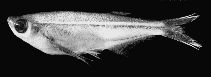
Milieu: milieu / Klimaatzone / Diepte / verspreidingsgebied
Ecologie
; zoet water pelagisch; potamodroom (Ref. 138296). Tropical; 24°C - 26°C (Ref. 2060)
Asia: Indochina, Thailand to Borneo and Java.
Grootte / Gewicht / Leeftijd
Maturiteit: Lm ? range ? - ? cm
Max length : 20.0 cm SL mannelijk / geslacht onbekend; (Ref. 2686); common length : 10.0 cm SL mannelijk / geslacht onbekend; (Ref. 57235)
Korte beschrijving
Determinatiesleutels | Morfologie | Morfometrie
Dorsal fin origin above the 3rd and 4th anal-fin ray; pectoral fin large with dark distal margin, extending beyond tip of pelvic fin; 31-33 branched anal-fin rays; dark outline on first few lateral canals; 20-21 gill rakers on 1st arch (Ref. 12693). Abdomen more or less greatly arched, with a sharp keel. Lower jaw with a symphyseal knob fitting into an emargination of symphysis of upper jaw. No barbels. Lateral line greatly recurved (Ref. 4792).
Body shape (shape guide): elongated.
Lives in rivers and lowland wetlands including peat canals (Ref. 57235). Found in medium to large-sized rivers and is a common resident of seasonally flooded forest. Leaves the flooded forest in November as the water levels begin to decline substantially. Seems to be more tolerant of high amounts of suspended solids than P. maculicauda or P. williaminae and are more common in habitats disturbed by farming activities. Feeds on zooplankton, insects (Ref. 12693) and fish (Ref. 56749). Normally sold in markets held side by side in a piece of split bamboo. Good for Tieo pa ka tao and extensively used for making padek (Ref. 7050).
Levenscyclus en paargedrag
Maturiteit | Voortplanting | Paaien | Eieren | Fecunditeit | Larven
Kottelat, M., A.J. Whitten, S.N. Kartikasari and S. Wirjoatmodjo, 1993. Freshwater fishes of Western Indonesia and Sulawesi. Periplus Editions, Hong Kong. 221 p. (Ref. 7050)
Status op de Rode Lijst van het IUCN (Ref. 130435: Version 2025-2 (Global))
Gevaar voor de mens
Harmless
Gebruik door de mens
Visserij: commercieel; Aquarium: Commercieel
Tools
Speciale rapporten
Download XML
Internetbronnen
Schattingen op basis van modellen
Fylogenetische diversiteitsindex (Ref.
82804): PD
50 = 0.5078 [Uniqueness, from 0.5 = low to 2.0 = high].
Bayesian length-weight: a=0.00661 (0.00351 - 0.01243), b=3.06 (2.90 - 3.22), in cm total length, based on LWR estimates for this species & (Sub)family-body (Ref.
93245).
Trofisch niveau (Ref.
69278): 3.3 ±0.43 se; based on food items.
Weerstandsvermogen (Ref.
120179): Gemiddeld, minimale populatieverdubbelingstijd 1,4-4,4 jaar (Preliminary K or Fecundity.).
Kwetsbaarheid van de visserij (Ref.
59153): Low vulnerability (14 of 100).
🛈
Voedingsstoffen (Ref.
124155): Calcium = 365 [171, 1,279] mg/100g; Iron = 1.49 [0.72, 3.16] mg/100g; Protein = 17.8 [16.7, 18.9] %; Omega3 = 0.403 [0.171, 0.933] g/100g; Selenium = 44.3 [16.7, 138.9] μg/100g; VitaminA = 173 [68, 436] μg/100g; Zinc = 2.34 [1.40, 3.65] mg/100g (wet weight);