>
Cyprinodontiformes (Rivulines, killifishes and live bearers) >
Cyprinodontidae (Pupfishes) > Cyprinodontinae
Etymology: Cyprinodon: Latin, cyprinus = carp + Greek, odous = teeth (Ref. 45335); ceciliae: Named for Cecilia Contreras Lozano.
Eponymy: Cecilia Contreras Lozano is the senior author’s daughter and the junior author’s niece. [...] (Ref. 128868), visit book page.
Environnement : milieu / zone climatique / profondeur / gamme de distribution
Écologie
; eau douce benthopélagique; non migrateur (Ref. 126106). Tropical
Central America: Nuevo Leon, Mexico.
Taille / Poids / Âge
Maturité: Lm ? range ? - ? cm
Max length : 7.0 cm TL mâle / non sexé; (Ref. 27139)
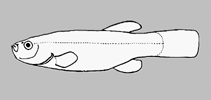
This species is distinguished from its congeners in having its unique coloration: nuptial males violaceous blue with 7-8 well marked dark bar, all extending to venter; females' dorsal fins blackish in the proximal two thirds, ocellus with round black spot usually smaller than pupil; anal usually with a posterior dark spot near its base; eye diameter 1.2-1.6 times and maxilla 0.83-1.2 times in anal base (similar to C. longidorsalis); postdorsal-postanal distance 0.9-1.0 times in caudal peduncle length; teeth absent on 4th ceratobranchial; anal base large 2.5-3.2 times in head length; head length 2.8-3.2 times in SL (Ref. 26729).
The area of collection is arid, with little vegetation, often succulents, also with thick shrubby growth around; the area is dusty, with poor soils and some cultivated fields nearby. Water is clear, bottom muddy; aquatic vegetation includes Chara and Scirpus; banks shrubby or meadowlike (Ref. 26729). Not a seasonal killifish (Ref. 27139).
Cycle de vie et comportement reproducteur
Maturité | Reproduction | Frai | Œufs | Fécondité | Larves
Lozano-Vilano, M. de L. and S. Conteras-Balderas, 1993. Four new species of Cyprinodon from southern Nuevo León, Mexico, with a key to the C. eximius complex (Teleostei: Cyprinodontidae). Ichthyol. Explor. Freshwat. 4(4):295-308. (Ref. 26729)
Statut dans la liste rouge de l'IUCN (Ref. 130435: Version 2025-2 (Global))
Menace pour l'homme
Harmless
Utilisations par l'homme
Outils
Articles particuliers
Télécharger en XML
Sources Internet
Estimations basées sur des modèles
Indice de diversité phylogénétique (Réf.
82804): PD
50 = 0.5000 [Uniqueness, from 0.5 = low to 2.0 = high].
Bayesian length-weight: a=0.00389 (0.00180 - 0.00842), b=3.12 (2.94 - 3.30), in cm total length, based on all LWR estimates for this body shape (Ref.
93245).
Niveau trophique (Réf.
69278): 2.5 ±0.1 se; based on size and trophs of closest relatives
Résilience (Réf.
120179): Milieu, temps minimum de doublement de population : 1,4 à 4,4 années (Assuming tm<1 and Fec<1000).
Vulnérabilité de la pêche (Ref.
59153): Low vulnerability (10 of 100).
🛈