>
Cyprinodontiformes (Rivulines, killifishes and live bearers) >
Cyprinodontidae (Pupfishes) > Orestiinae
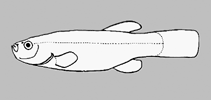
Etymology: Orestias: After Orestes in the Greek mythology?.
Eponymy: Orestis or Orestes is a Greek name meaning “he who stands on the mountain”. [...] Polonorum is Latin for ‘of the Poles’ and commemorates the expedition funded by Branicki to South America (1866–1867) during which the first example of this species was collected by the Polish naturalist Constantin Jelski (q.v.). (Ref. 128868), visit book page.
Environnement : milieu / zone climatique / profondeur / gamme de distribution
Écologie
; eau douce benthopélagique; non migrateur. Tropical
South America: Junin Lake, Peru.
Taille / Poids / Âge
Maturité: Lm ? range ? - ? cm
Max length : 14.5 cm TL mâle / non sexé; (Ref. 27139)
Not a seasonal killifish (Ref. 27139).
Cycle de vie et comportement reproducteur
Maturité | Reproduction | Frai | Œufs | Fécondité | Larves
Costa, W.J.E.M., 2003. Cyprinodontidae (Pupfishes). p. 549-554. In R.E. Reis, S.O. Kullander and C.J. Ferraris, Jr. (eds.) Checklist of the Freshwater Fishes of South and Central America. Porto Alegre: EDIPUCRS, Brasil. (Ref. 50471)
Statut dans la liste rouge de l'IUCN (Ref. 130435: Version 2025-2 (Global))
Menace pour l'homme
Harmless
Utilisations par l'homme
Outils
Articles particuliers
Télécharger en XML
Sources Internet
Estimations basées sur des modèles
Indice de diversité phylogénétique (Réf.
82804): PD
50 = 0.5000 [Uniqueness, from 0.5 = low to 2.0 = high].
Bayesian length-weight: a=0.00389 (0.00180 - 0.00842), b=3.12 (2.94 - 3.30), in cm total length, based on all LWR estimates for this body shape (Ref.
93245).
Niveau trophique (Réf.
69278): 3.1 ±0.4 se; based on size and trophs of closest relatives
Vulnérabilité de la pêche (Ref.
59153): Low vulnerability (10 of 100).
🛈