>
Eupercaria/misc (Various families in series Eupercaria) >
Labridae (Wrasses) > Scarinae
Etymology: Chlorurus: Greek, chloros = green + Greek oura = tail (Ref. 45335).
Eponymy: Dr Pieter Bleeker (1819–1878) was an ichthyologist and army surgeon commissioned (1841) by the Dutch East India Company. [...] (Ref. 128868), visit book page.
Meio ambiente: milieu / Zona climática / intervalo de profundidade / faixa de distribuição
Ecologia
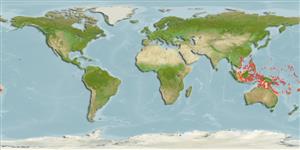
marinhas associadas(os) a recifes; intervalo de profundidade 0 - 35 m (Ref. 90102), usually 5 - 25 m (Ref. 9793). Tropical; 21°N - 25°S, 104°E - 174°W
Indo-Pacific: East Indian region to Micronesia, Samoa, and Fiji and Philippines to Australia; throughout East Indian region except Andaman Sea.
Tamanho / Peso / Idade
Maturidade: Lm ? range ? - ? cm
Max length : 49.0 cm TL macho/indeterminado; (Ref. 9710)
Descrição suscinta
Chaves de identificação | Morfologia | Morfometria
Espinhos dorsais (total) : 9; Raios dorsais (total) : 10; Espinhos anais: 3; Raios anais : 9. This species is distinguished by the following characters: median predorsal scales 5-7 (usually 6); 2 scale rows on cheek, 1(6-8), 2(6-8); pectoral-fin rays 15; dental plates well exposed, lips not covering the plates; 1-2 conical teeth on side of upper dental plate; caudal fin truncate. Colour of initial phase (IP) dark brown with broad pale bars on sides and pale caudal fin and caudal peduncle; male with greenish large pale cream patch below eye bordered entirely by a thick green line. Male greenish with pink scale edges, green central zone and outer margins on tail and large rectangular whitish area on cheek; female dark brown with 3-4 broad pale bars (Ref. 9793, 90102, 117228).
Body shape (shape guide): short and / or deep; Cross section: compressed.
Found in clear coastal and inner reefs (Ref. 48636); in lagoons and channel reefs (Ref. 2334). Feeds by scraping algae from the substrate (Ref. 26993). Females usually in small groups and maybe mixed with other species when feeding; males solitary nearby (Ref. 48636). Minimum depth reported taken from Ref. 128797.
Ciclo de vida ou comportamento de acasalamento
Maturidade | Reprodução | Desova | Ovos | Fecundidade | Larvas
Oviparous, distinct pairing during breeding (Ref. 205).
Randall, J.E., G.R. Allen and R.C. Steene, 1990. Fishes of the Great Barrier Reef and Coral Sea. University of Hawaii Press, Honolulu, Hawaii. 506 p. (Ref. 2334)
Status na Lista Vermelha da UICN (Ref. 130435: Version 2025-2 (Global))
Ameaça para os humanos
Harmless
Uso pelos humanos
Pescarias: pouco comercial; Aquário: Espécies comerciais
Ferramentas
Relatórios especiais
Baixar XML
Fontes da internet
Estimativas baseadas em modelos
Temperatura preferida (Ref.
123201): 25.8 - 29.3, mean 28.6 °C (based on 1692 cells).
Índice de diversidade filogenética (Ref.
82804): PD
50 = 0.5000 [Uniqueness, from 0.5 = low to 2.0 = high].
Bayesian length-weight: a=0.02089 (0.01146 - 0.03808), b=2.99 (2.83 - 3.15), in cm total length, based on LWR estimates for this species & (Sub)family-body (Ref.
93245).
Nível Trófico (Ref.
69278): 2.0 ±0.00 se; based on food items.
Resiliência (Ref.
120179): médio(a), tempo mínimo de duplicação da população 1,4 - 4,4 anos (Preliminary K or Fecundity.).
Vulnerabilidade da pesca (Ref.
59153): Moderate vulnerability (39 of 100).
🛈
Nutrientes (Ref.
124155): Calcium = 29.6 [9.5, 107.8] mg/100g; Iron = 0.556 [0.210, 1.463] mg/100g; Protein = 18.2 [16.1, 20.2] %; Omega3 = 0.0691 [, ] g/100g; Selenium = 40.8 [12.1, 129.1] μg/100g; VitaminA = 30 [7, 121] μg/100g; Zinc = 1.73 [0.73, 3.23] mg/100g (wet weight);