Umwelt: Milieu / Klimazone / Tiefenbereich / Verbreitungsgebiet
Ökologie
seewasser; brackwasser demersal; tiefenbereich 0 - 30 m (Ref. 6390). Subtropical; 17°S - 38°S
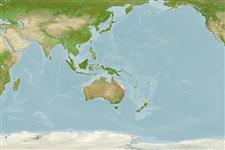
Western Pacific: endemic to Australia. Present along the east coast between approximately Cairns, Queensland (Ref.27242) and Gippsland lakes in eastern Victoria.
Länge bei der ersten Reifung / Größe / Gewicht / Alter
Geschlechtsreife: Lm 50.2 range ? - ? cm
Max length : 120 cm TL Männchen/unbestimmt; (Ref. 27112); max. veröff. Gewicht: 15.0 kg (Ref. 27248)
Rückenflossenstacheln (insgesamt) : 8 - 9; Rückenflossenweichstrahlen (insgesamt) : 13 - 14; Afterflossenstacheln: 0; Afterflossenweichstrahlen: 13 - 14; Wirbelzahl: 27.
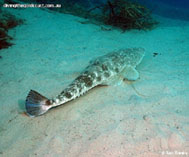
Body shape (shape guide): elongated.
Generally inhabit shallow bays and inlets and can be found in estuaries as far as tidal limits (Ref. 27246); they often invade freshwater. They occur over mud, silt gravel, sand and seagrass (mainly Zostera species) beds from intertidal areas to depths of 10 m in Queensland and to 30 m in southern New South Wales. Eggs and larvae are dispersed along the coast by tidal and current movements (Ref. 27112). Small juveniles less than 12 cm TL first appear in coastal bays 1-2 months after spawning. They mainly inhabit shallow mangrove and mud flats and seagrass beds (Ref. 27246, 27245). They are usually solitary but may form loose aggregations (Ref. 2165, 27247). Feed on small fish, crabs, prawns, small crustaceans. octopus, squid and polychaete worms. They have spines on the outer edges of their head which can inflict nasty cuts during handling (pers. comm., Bernard Moss, 2001).
There is conflicting information (Ref. 27246, 27245, 27247) on whether dusky flahead are protandrous sex reversers or not.
Paxton, J.R., D.F. Hoese, G.R. Allen and J.E. Hanley, 1989. Pisces. Petromyzontidae to Carangidae. Zoological Catalogue of Australia, Vol. 7. Australian Government Publishing Service, Canberra, 665 p. (Ref. 7300)
IUCN Rote Liste Status (Ref. 130435: Version 2025-2 (Global))
Bedrohung für Menschen
Harmless
Nutzung durch Menschen
Fischereien: kommerziell; Sportfisch: ja
Tools
Zusatzinformationen
Download XML
Internet Quellen
Schätzungen auf der Grundlage von Modellen
Bevorzugte Temperatur (Ref.
123201): 19.1 - 27.1, mean 25.2 °C (based on 291 cells).
Phylogenetischer Diversitätsindex (Ref.
82804): PD
50 = 0.5000 [Uniqueness, from 0.5 = low to 2.0 = high].
Bayesian length-weight: a=0.00427 (0.00219 - 0.00832), b=3.11 (2.94 - 3.28), in cm total length, based on LWR estimates for this (Sub)family-body shape (Ref.
93245).
Trophische Ebene (Ref.
69278): 4.1 ±0.52 se; based on food items.
Widerstandsfähigkeit (Ref.
120179): mittel, Verdopplung der Population dauert 1,4 - 4,4 Jahre. (K=0.22; tm=2).
Anfälligkeit der Fischerei (Ref.
59153): High to very high vulnerability (72 of 100).
🛈
Nährstoffe (Ref.
124155): Calcium = 132 [8, 523] mg/100g; Iron = 2.27 [0.58, 6.12] mg/100g; Protein = 19.2 [16.9, 21.6] %; Omega3 = 0.481 [0.216, 1.350] g/100g; Selenium = 54.4 [13.6, 213.1] μg/100g; VitaminA = 4.35 [1.42, 12.68] μg/100g; Zinc = 0.72 [0.34, 1.57] mg/100g (wet weight);