Ambiente: milieu / zona climatica / distribuzione batimetrica / gamma di distribuzione
Ecologia
; acqua dolce benthopelagico; pH range: 6.0 - 8.3; dH range: 2 - 3; potamodromo (Ref. 51243); distribuzione batimetrica 4 - ? m (Ref. 9987). Tropical; 23°C - 28°C (Ref. 1672); 20°N - 22°S
Asia: Mekong basin in Laos, Thailand, Cambodia and Vietnam; also Chao Phraya basin (Ref. 43281). Introduced elsewhere and at least one country reports adverse ecological impact after introduction (Ref. 1739).
Dimensione / Peso / Età
Maturità: Lm ? range ? - ? cm
Max length : 25.0 cm TL maschio/sesso non determinato; (Ref. 6028); common length : 15.0 cm TL maschio/sesso non determinato; (Ref. 2686); peso massimo pubblicato: 500.00 g (Ref. 6028)
Breve descrizione
Chiavi di identificazione | Morfologia | Morfometria
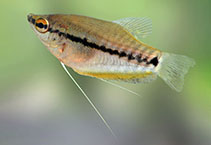
Spine dorsali (totale) : 7 - 8; Raggi dorsali molli (totale) : 10 - 11; Spine anali: 9 - 12; Raggi anali molli: 33 - 38. Dorsal fin with short spines and long soft rays. Caudal fin slightly emarginate. First soft ray of pelvic fins prolonged into a tentacle extending posteriorly to hind margin of caudal fin. Body with numerous dark oblique cross bands which are not always distinct; presence of irregular black stripe from eye to middle of caudal fin base (Ref. 43281).
Body shape (shape guide): short and / or deep; Cross section: compressed.
Obligate air-breathing (Ref. 126274); Found in shallow sluggish or standing-water habitats with a lot of aquatic vegetation. Occurs in flooded forests of the lower Mekong and gradually moves back to rivers and Great Lake as floodwaters recede (Ref. 12693, 57235). Generally feeds on aquatic plants. Can breathe air directly, as well as absorb oxygen from water through its gills (Ref. 9987). The flesh is of good quality; may be grilled or used for fish soup. In Thailand there is a trade of dried pla salid for the benefit of people in areas where it is not caught (Ref 2686). Cultured both for food and for export as aquarium fish (Ref. 9987). Marketed fresh (Ref. 12693). Highly economic species; both by capture and culture includes in the peat areas (Ref. 57235).
Ciclo vitale e comportamento di accoppiamento
Maturità | Riproduzione | Deposizione | Uova | Fecondità | Larve
Male creates a bubble-nest at the surface. After fertilization, male, with the use of its mouth, collects the eggs and pushes them up into the bubble-nest (Ref. 6459). Male guards the eggs until hatching (Ref. 9987); both parents care for the young (Ref. 6028).
Rainboth, W.J., 1996. Fishes of the Cambodian Mekong. FAO species identification field guide for fishery purposes. FAO, Rome, 265 p. (Ref. 12693)
Stato della Lista Rossa IUCN (Ref. 130435: Version 2025-2 (Global))
Minaccia per l'uomo
Potential pest (Ref. 6095)
Usi umani
Pesca: commerciale; Acquacoltura: commerciale
Strumenti
Rapporti speciali
Scarica XML
Fonti Internet
Stime basate su modelli
Indice di diversità filogenetica (Fonte Biblio.
82804): PD
50 = 0.5156 [Uniqueness, from 0.5 = low to 2.0 = high].
Bayesian length-weight: a=0.01318 (0.00795 - 0.02185), b=3.06 (2.92 - 3.20), in cm total length, based on LWR estimates for this species & (Sub)family-body (Ref.
93245).
Livello trofico (Fonte Biblio.
69278): 2.8 ±0.1 se; based on diet studies.
Resilienza (Fonte Biblio.
120179): Medio, tempo minimo di raddoppiamento della popolazione 1.4 - 4.4 anni (Fec=1,000-10,000 eggs (Ref.
6459)).
Vulnerabilità della pesca (Ref.
59153): Low vulnerability (15 of 100).
🛈
Nutrienti (Ref.
124155): Calcium = 54.3 [23.6, 246.2] mg/100g; Iron = 1.14 [0.50, 2.51] mg/100g; Protein = 18.4 [16.7, 19.8] %; Omega3 = 0.233 [0.083, 0.638] g/100g; Selenium = 38.7 [14.9, 93.9] μg/100g; VitaminA = 27.7 [7.1, 118.2] μg/100g; Zinc = 2.55 [1.22, 5.01] mg/100g (wet weight); based on
nutrient studies.