Élasmobranches (requins et raies) (sharks and rays) >
Carcharhiniformes (Ground sharks) >
Hemigaleidae (Weasel sharks)
Etymology: Paragaleus: para (Gr.), near, referring to how its dentition is intermediate between Hemigaleus and the triakid Eugaleus (=Galeorhinus) (See ETYFish); pectoralis: Latin for pectoral, allusion not explained, possibly referring to its characteristic falciform pectoral fins (See ETYFish).
More on author: Garman.
Environnement : milieu / zone climatique / profondeur / gamme de distribution
Écologie
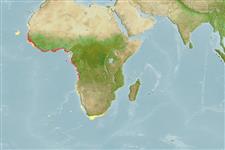
marin démersal; profondeur ? - 100 m (Ref. 5578), usually 30 - 70 m (Ref. 10730). Tropical; 30°N -
Eastern Atlantic: Cape Verde and Mauritania to northern Namibia (Ref. 244, 5578); possibly extending north to Morocco. Record from the Northwest Atlantic, specifically in New England, has not been verified even after an extensive survey of the area has been conducted.
Longueur à la première maturité / Taille / Poids / Âge
Maturité: Lm 82.5, range 75 - 90 cm
Max length : 140 cm TL mâle / non sexé; (Ref. 5578); common length : 100.0 cm TL mâle / non sexé; (Ref. 26999); poids max. publié: 7.2 kg (Ref. 132927)
Description synthétique
Clés d'identification | Morphologie | Morphométrie
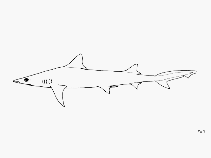
Épines dorsales (Total) : 0; Épines anales: 0. A slender weasel shark with a moderately long snout, large eyes, and a short, small mouth with small, serrated upper teeth and erect-cusped lower teeth (Ref. 5578). Light grey or bronze with longitudinal yellow stripes, fins plain; white below (Ref. 5578).
Body shape (shape guide): elongated.
A very common inshore to offshore shark of the continental shelf occurring at depths of a few meters to slightly over 100 m (Ref. 244). A specialist feeder that prefers cephalopods, also feeds on small bony fishes (Ref. 244). Viviparous (Ref. 50449). Utilized fresh and dried salted for human consumption, and processed into fishmeal (Ref. 244).
Cycle de vie et comportement reproducteur
Maturité | Reproduction | Frai | Œufs | Fécondité | Larves
Viviparous (with a yolk-sac placenta), with 1 to 4 young per litter. Size at birth about 47 cm (Ref. 244). Distinct pairing with embrace (Ref. 205).
Compagno, L.J.V., 1984. FAO Species Catalogue. Vol. 4. Sharks of the world. An annotated and illustrated catalogue of shark species known to date. Part 2 - Carcharhiniformes. FAO Fish. Synop. 125(4/2):251-655. Rome: FAO. (Ref. 244)
Statut dans la liste rouge de l'IUCN (Ref. 130435: Version 2025-2 (Global))
Menace pour l'homme
Harmless
Utilisations par l'homme
Pêcheries: commercial
Outils
Articles particuliers
Télécharger en XML
Sources Internet
Estimations basées sur des modèles
Température préférée (Réf.
123201): 17.7 - 25.9, mean 19.9 °C (based on 45 cells).
Indice de diversité phylogénétique (Réf.
82804): PD
50 = 0.5664 [Uniqueness, from 0.5 = low to 2.0 = high].
Bayesian length-weight: a=0.00269 (0.00140 - 0.00518), b=3.07 (2.90 - 3.24), in cm total length, based on LWR estimates for this species & (Sub)family-body (Ref.
93245).
Niveau trophique (Réf.
69278): 4.3 ±0.64 se; based on food items.
Résilience (Réf.
120179): Très faible, temps minimum de doublement de population supérieur à 14 ans (Fec=1).
Vulnérabilité de la pêche (Ref.
59153): Very high vulnerability (84 of 100).
🛈