>
Eupercaria/misc (Various families in series Eupercaria) >
Haemulidae (Grunts) > Haemulinae
Etymology: Orthopristis: Greek, ortho = straight + Greek, pristis = saw (Ref. 45335).
More on author: Linnaeus.
Entorno: milieu / zona climática / rango de profundidad / gama de distribución
Ecología
marino; salobre demersal; oceanodromo (Ref. 51243); rango de profundidad 10 - ? m (Ref. 25). Temperate; 41°N - 10°N, 99°W - 60°W
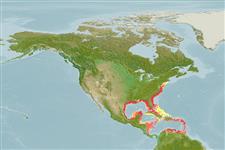
Western Atlantic: New York, USA and Bermuda to Mexico.
Longitud en la primera madurez / Tamaño / Peso / Edad
Madurez: Lm 20.0 range ? - ? cm
Max length : 46.0 cm SL macho / no sexado; (Ref. 25); common length : 30.0 cm TL macho / no sexado; (Ref. 3798); peso máximo publicado: 900.00 g (Ref. 25); edad máxima reportada: 4 años (Ref. 25)
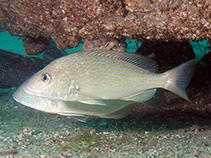
Espinas dorsales (total) : 12 - 13; Radios blandos dorsales (total) : 15 - 16; Espinas anales: 3; Radios blandos anales: 12 - 13. Back elevated; snout long and tapering. Mouth a little oblique; maxillary reaching vertical from first nostril. Scales in oblique rows above lateral line and horizontal rows below lateral line, extending on base of caudal, pelvic and pectoral fins; also forming a low sheath on base of anal and dorsal fins.
Body shape (shape guide): short and / or deep; Cross section: compressed.
Inhabits coastal waters, over sand and mud bottoms. Forms schools. Mainly nocturnal and non-burrowing. Feeds on crustaceans and smaller fishes. Undergoes seasonal migration as well as local nocturnal-diurnal foraging migrations (Ref. 25).
Spawning may occur in open water just prior to inshore migration or in quiet inshore waters, such as harbors, estuaries, and inshore banks, but may begin on outer shores first. Pigfish spawn at dusk exclusively. In general, larger fish spawn first, with smaller ones spawning latest in the season.
Darcy, G.H., 1983. Synopsis of biological data on the pigfish, Orthopristis chrysoptera (Pisces: Haemulidae). FAO Fish. Synop. (134); NOAA Tech. Rep. NMFS Circ. (449). (Ref. 25)
Situación en la Lista Roja de la UICN (Ref. 130435: Version 2025-2 (Global))
Amenaza para el ser humano
Harmless
Usos humanos
Pesquerías: escaso valor comercial; Acuario: Acuarios públicos; carnada: usually
Herramientas
Informes especiales
Descargar XML
Fuentes de Internet
Estimaciones basadas en modelos
Temperatura preferida (Referencia
123201): 15.5 - 27.8, mean 24.4 °C (based on 232 cells).
Índice de diversidad filogenética (Referencia
82804): PD
50 = 0.5156 [Uniqueness, from 0.5 = low to 2.0 = high].
Bayesian length-weight: a=0.01549 (0.01242 - 0.01931), b=3.02 (2.96 - 3.08), in cm total length, based on LWR estimates for this species (Ref.
93245).
Nivel trófico (Referencia
69278): 3.4 ±0.0 se; based on diet studies.
Generation time: 6.1 ( na - na) years. Estimated as median ln(3)/K based on 2
growth studies.
Resiliencia (Referencia
120179): Medio, población duplicada en un tiempo mínimo de 1.4-4.4 años (K=0.18-0.46; tmax=4).
Vulnerabilidad pesquera (Ref.
59153): Low to moderate vulnerability (30 of 100).
🛈
Vulnerabilidad climática (Ref.
125649): High to very high vulnerability (75 of 100).
🛈
Nutrientes (Ref.
124155): Calcium = 32.1 [10.0, 72.4] mg/100g; Iron = 0.332 [0.169, 0.681] mg/100g; Protein = 18.5 [16.6, 20.5] %; Omega3 = 0.446 [0.203, 0.892] g/100g; Selenium = 11.1 [5.4, 23.4] μg/100g; VitaminA = 9.22 [2.89, 28.64] μg/100g; Zinc = 0.579 [0.380, 0.871] mg/100g (wet weight);