Classificazione / Nomi
Nomi Comuni | Sinonimi | Catalog of Fishes(Genere, Specie) | ITIS | CoL | WoRMS | Cloffa
>
Holocentriformes (Squirrelfishes, soldierfishes) >
Holocentridae (Squirrelfishes, soldierfishes) > Holocentrinae
Etymology: Sargocentron: Greek, sargos = sargus + Greek, kentron = sting (Ref. 45335); hormion: From the Greek word 'hormion' meaning necklace or string of things, referring to the conspicuous series of 6 white spots anteriorly in the red spinous part of the dorsal fin.
More on author: Randall.
Ambiente: milieu / zona climatica / distribuzione batimetrica / gamma di distribuzione
Ecologia
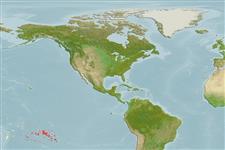
marino associati a barriera corallina; distribuzione batimetrica 1 - 42 m (Ref. 27370). Tropical
Pacific Ocean: Cook Islands, Pitcairn, and French Polynesia.
Dimensione / Peso / Età
Maturità: Lm ? range ? - ? cm
Max length : 16.6 cm SL maschio/sesso non determinato; (Ref. 27370)
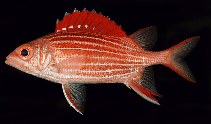
Spine dorsali (totale) : 11; Raggi dorsali molli (totale) : 13 - 14; Spine anali: 4; Raggi anali molli: 8 - 10; Vertebre: 27. Body striped red and silvery white, the red stripes about 3 times as broad as the white; spinous part of dorsal fin red except for white tips and a row of 6 white spots, one per membrane, near the base of the fin. Upper edge of suborbital bones below anterior half of orbit spineless and not serrate; small spine at medioposterior margin of nasal bone usually absent; nasal fossa without spinules; small preopercular spine, usually less than half orbit diameter; body depth 2.8-3.1 in SL; head length 2.7-3.05 in SL; longest dorsal spines, 1.9-2.2 in head length; third anal spine 1.2-1.45 in head length. Anal rays usually 9; pectoral usually 5 (Ref. 27370).
Body shape (shape guide): fusiform / normal; Cross section: oval.
Occurs on rocky bottom or coral reefs (Ref. 27370).
Ciclo vitale e comportamento di accoppiamento
Maturità | Riproduzione | Deposizione | Uova | Fecondità | Larve
Randall, J.E., 1998. Revision of the Indo-Pacific squirrelfishes (Beryciformes: Holocentridae: Holocentrinae) of the genus Sargocentron, with descriptions of four new species. Indo-Pac. Fish. (27):105 p. (Ref. 27370)
Stato della Lista Rossa IUCN (Ref. 130435: Version 2025-2 (Global))
Minaccia per l'uomo
Harmless
Usi umani
Strumenti
Rapporti speciali
Scarica XML
Fonti Internet
Stime basate su modelli
Temperatura preferita (Fonte Biblio.
123201): 25.1 - 28.3, mean 27.4 °C (based on 113 cells).
Indice di diversità filogenetica (Fonte Biblio.
82804): PD
50 = 0.5000 [Uniqueness, from 0.5 = low to 2.0 = high].
Bayesian length-weight: a=0.01698 (0.00810 - 0.03560), b=2.96 (2.79 - 3.13), in cm total length, based on LWR estimates for this Genus-body shape (Ref.
93245).
Livello trofico (Fonte Biblio.
69278): 3.5 ±0.3 se; based on size and trophs of closest relatives
Resilienza (Fonte Biblio.
120179): Alto, tempo minimo di raddoppiamento della popolazione meno di 15 mesi (Preliminary K or Fecundity.).
Vulnerabilità della pesca (Ref.
59153): Low vulnerability (10 of 100).
🛈
Nutrienti (Ref.
124155): Calcium = 71.9 [28.6, 272.6] mg/100g; Iron = 0.567 [0.229, 1.721] mg/100g; Protein = 18.5 [17.3, 19.6] %; Omega3 = 0.153 [0.066, 0.351] g/100g; Selenium = 30.7 [18.4, 58.3] μg/100g; VitaminA = 87.7 [33.9, 234.5] μg/100g; Zinc = 2.13 [0.90, 4.08] mg/100g (wet weight);