>
Ovalentaria/misc (Various families in series Ovalentaria) >
Opistognathidae (Jawfishes)
Etymology: Opistognathus: Greek, opisthe = behind + Greek, gnathos = jaw (Ref. 45335); to the very elongate upper jaw of the type species of the genus, Opistognathus nigromarginatus (Ref. 128653).
Eponymy: Georges Léopold Chrétien Frédéric Dagobert Baron Cuvier (1769–1832), better known by his pen name Georges Cuvier, was a French naturalist and one of the scientific giants of his age. [...] (Ref. 128868), visit book page.
More on author: Valenciennes.
Environnement : milieu / zone climatique / profondeur / gamme de distribution
Écologie
marin récifal; profondeur 1 - 35 m (Ref. 129348). Tropical
Southwest Atlantic: southern Brazil.
Taille / Poids / Âge
Maturité: Lm ? range ? - ? cm
Max length : 11.4 cm SL mâle / non sexé; (Ref. 26893)
Description synthétique
Clés d'identification | Morphologie | Morphométrie
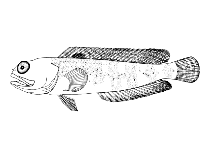
Épines dorsales (Total) : 11; Rayons mous dorsaux (Total) : 16; Épines anales: 3; Rayons mous anaux: 16. Anterior nostril a short tube with simple cirrus on posterior rim; posterior end of maxilla of adult males produced as a thin flexible lamina that usually extends beyond posterior margin of opercle; spinous dorsal fin with a dark spot encircled by broad white ring; adult males with inner lining of maxilla and adjacent membranes with two dark stripes (innermost stripe not well developed), no stripes in females; buccal pigmentation consisting of a dark blotch on either side of esophageal opening widely separated by pale median area that continues between upper pharyngeals; caudal vertebrae 19 (Ref. 26893).
Body shape (shape guide): elongated.
Occurs in coastal waters, on gravel and sand or silt and sand bottoms, near coral reefs and rocky areas and observed resting on the bottom or in burrows (Ref. 129348). Mouthbrooders (Ref. 240).
Cycle de vie et comportement reproducteur
Maturité | Reproduction | Frai | Œufs | Fécondité | Larves
Employ mouthbrooding to care for their young (Ref. 240).
Smith-Vaniz, W.F., 1997. Five new species of jawfishes (Opistognathus: Opistognathidae) from the western Atlantic ocean. Bull. Mar. Sci. 60(3):1074-1128. (Ref. 26893)
Statut dans la liste rouge de l'IUCN (Ref. 130435: Version 2025-2 (Global))
Menace pour l'homme
Harmless
Utilisations par l'homme
Outils
Articles particuliers
Télécharger en XML
Sources Internet
Estimations basées sur des modèles
Indice de diversité phylogénétique (Réf.
82804): PD
50 = 0.5000 [Uniqueness, from 0.5 = low to 2.0 = high].
Bayesian length-weight: a=0.00389 (0.00180 - 0.00842), b=3.12 (2.94 - 3.30), in cm total length, based on all LWR estimates for this body shape (Ref.
93245).
Niveau trophique (Réf.
69278): 3.5 ±0.6 se; based on size and trophs of closest relatives
Vulnérabilité de la pêche (Ref.
59153): Low vulnerability (10 of 100).
🛈