Élasmobranches (requins et raies) (sharks and rays) >
Rajiformes (Skates and rays) >
Rajidae (Skates)
Etymology: Raja: Latin, raja, -ae = a sting ray (Raja sp.) (Ref. 45335); straeleni: Named after V. Van Straelen, director of IRSNB, Belgium (Ref. 377).
Eponymy: Professor Victor Émile van Straelen (1889–1964) was a Belgian geologist, palaeontologist, carcinologist and naturalist. [...] (Ref. 128868), visit book page.
More on author: Poll.
Environnement : milieu / zone climatique / profondeur / gamme de distribution
Écologie
marin démersal; océanodrome; profondeur 80 - 800 m (Ref. 11284), usually 100 - 300 m (Ref. 26999). Tropical; 15°N - 30°S
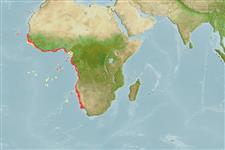
Eastern Atlantic: Rio de Oro, Western Sahara to South Africa.
Taille / Poids / Âge
Maturité: Lm ? range ? - ? cm
Max length : 70.0 cm TL mâle / non sexé; (Ref. 26999); 67.0 cm TL (female); poids max. publié: 1.4 kg (Ref. 377); poids max. publié: 1.4 kg
Description synthétique
Clés d'identification | Morphologie | Morphométrie
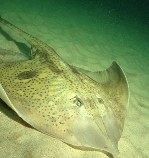
A black-spotted skate with a blunt, angular snout, a long, stout tail, and a broad angular disc; strong thorns on upper surface of disc and tail at all stages, sometimes on underside in large individuals (Ref. 5578). Brown to grey dorsally, with small to large black spots, whorls and blotches; many with gold and black, traversely oblong eyespot on each pectoral base; white ventrally with no dark pores (Ref. 5578). Juveniles have no dark spots above (Ref. 2708).
Body shape (shape guide): other.
Found in shallow enclosed bays and on the slope (Ref. 5578). Feeds on invertebrates, bony fishes and fish offal. Oviparous (Ref. 50449). Eggs have horn-like projections on the shell (Ref. 205). Caught by shore and ski-boat anglers and by hake trawlers. Pectoral fins sold as 'skate wings' (Ref. 5578). Undergoes regular migration, towards the coast during the warm season and towards deep waters in winter (Ref. 5377).
Cycle de vie et comportement reproducteur
Maturité | Reproduction | Frai | Œufs | Fécondité | Larves
Oviparous, paired eggs are laid. Embryos feed solely on yolk (Ref. 50449).
McEachran, J.D. and K.A. Dunn, 1998. Phylogenetic analysis of skates, a morphologically conservative clade of elasmobranchs (Chondrichthyes: Rajidae). Copeia 1998(2):271-290. (Ref. 27314)
Statut dans la liste rouge de l'IUCN (Ref. 130435: Version 2025-2 (Global))
Menace pour l'homme
Harmless
Utilisations par l'homme
Pêcheries: commercial; pêche sportive: oui
Outils
Articles particuliers
Télécharger en XML
Sources Internet
Estimations basées sur des modèles
Température préférée (Réf.
123201): 10.2 - 15.7, mean 12.3 °C (based on 76 cells).
Indice de diversité phylogénétique (Réf.
82804): PD
50 = 0.5000 [Uniqueness, from 0.5 = low to 2.0 = high].
Bayesian length-weight: a=0.00372 (0.00231 - 0.00597), b=3.20 (3.07 - 3.33), in cm total length, based on LWR estimates for this species & Genus-body shape (Ref.
93245).
Niveau trophique (Réf.
69278): 4.0 ±0.62 se; based on food items.
Résilience (Réf.
120179): Faible, temps minimum de doublement de population : 4,5 à 14 années (Fec assumed to be <100).
Vulnérabilité de la pêche (Ref.
59153): Moderate to high vulnerability (48 of 100).
🛈