Klassifizierung / Names
Namen | Synonyme | Catalog of Fishes(Gattung, Arten) | ITIS | CoL | WoRMS | Cloffa
>
Cichliformes (Cichlids, convict blennies) >
Cichlidae (Cichlids) > Pseudocrenilabrinae
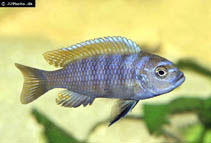
Etymology: Maylandia: In honour of Hans J. Mayland, German ictiologist (Ref. 45335); pyrsonotos: The name pyrsonotos, from the Greek, meaning red-backed to note the red dorsal fin (Ref. 27596).
Eponymy: Hans-Joachim Mayland (1928–2004) was a German ichthyologist, aquarist, photographer and writer. [...] (Ref. 128868), visit book page.
Umwelt: Milieu / Klimazone / Tiefenbereich / Verbreitungsgebiet
Ökologie
; süßwasser demersal. Tropical
Africa: Lake Malawi in Malawi (Ref. 27596).
Größe / Gewicht / Alter
Geschlechtsreife: Lm ? range ? - ? cm
Max length : 8.6 cm SL Männchen/unbestimmt; (Ref. 27596)
Kurzbeschreibung
Bestimmungsschlüssel | Morphologie | Morphometrie
Rückenflossenstacheln (insgesamt) : 13 - 18; Rückenflossenweichstrahlen (insgesamt) : 8 - 10; Afterflossenstacheln: 3; Afterflossenweichstrahlen: 6 - 9. Diagnosis: The moderately sloped head, swollen rostral tip of the neurocranium, isognathous jaws, and the presence of bicuspid teeth in the outer rows of the jaws place this species in Maylandia (Ref. 27596). The red dorsal fin in combination with black bars on a blue ground colour distinguish this species from all other members of the genus except for Maylandia emmiltos, which also has a red dorsal fin; Maylandia pyrsonotos differs from all the other red top BB forms in that the vertical black lateral bars infiltrate the proximal portion of the dorsal fin (Ref. 27596).
Body shape (shape guide): fusiform / normal.
Found at rocky shores (Ref. 27596).
Lebenszyklus und Paarungsverhalten
Geschlechtsreife | Fortpflanzung | Ablaichen | Eier | Fruchtbarkeit | Larven
Stauffer, J.R. Jr., N.J. Bowers, K.A. Kellogg and K.R. McKaye, 1997. A revision of the blue-black Pseudotropheus zebra (Teleostei: Cichlidae) complex from Lake Malawi, Africa, with a description of a new genus and ten new species. Proc. Acad. Nat. Sci. Philad. 148:189-230. (Ref. 27596)
IUCN Rote Liste Status (Ref. 130435: Version 2025-2 (Global))
Bedrohung für Menschen
Harmless
Nutzung durch Menschen
Tools
Zusatzinformationen
Download XML
Internet Quellen
Schätzungen auf der Grundlage von Modellen
Phylogenetischer Diversitätsindex (Ref.
82804): PD
50 = 0.5000 [Uniqueness, from 0.5 = low to 2.0 = high].
Bayesian length-weight: a=0.01445 (0.00671 - 0.03113), b=2.99 (2.82 - 3.16), in cm total length, based on LWR estimates for this (Sub)family-body shape (Ref.
93245).
Widerstandsfähigkeit (Ref.
120179): hoch, Verdopplung der Population dauert weniger als 15 Monate. (Preliminary K or Fecundity.).
Anfälligkeit der Fischerei (Ref.
59153): Low vulnerability (10 of 100).
🛈