Entorno: milieu / zona climática / rango de profundidad / gama de distribución
Ecología
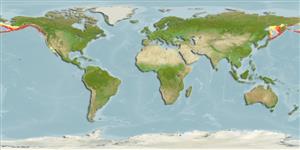
marino batidemersal; oceanodromo (Ref. 87829); rango de profundidad 0 - 825 m (Ref. 6793), usually 165 - 293 m (Ref. 27437). Deep-water; 64°N - 24°N, 143°E - 110°W (Ref. 54884)
North Pacific: Honshu, Japan to Cape Navarin in the Bering Sea (but not in the Sea of Okhotsk) and La Jolla, California, and along the Aleutians from Stalemate Bank and Bowers Bank to the Alaska Peninsula. Stocks have suffered severe population decline due to overfishing (Ref. 27437).
Longitud en la primera madurez / Tamaño / Peso / Edad
Madurez: Lm 33.2, range 25 - 43.3 cm
Max length : 53.0 cm TL macho / no sexado; (Ref. 56527); peso máximo publicado: 2.1 kg (Ref. 56527); edad máxima reportada: 103 años (Ref. 93933)
Descripción breve
Claves de identificación | Morfología | Morfometría
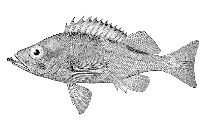
Espinas dorsales (total) : 13; Radios blandos dorsales (total) : 14 - 17; Espinas anales: 3; Radios blandos anales: 6 - 9; Vértebra: 26. Head spines weak - nasal, preocular, supraocular (may be absent), postocular, tympanic, parietal, and nuchal (may be absent) spines present, coronal spine absent (Ref. 27437). Long lower jaw with prominent forward directed symphyseal knob (Ref. 27437). Posterior margin of caudal indented (Ref. 6885). Bright to light red, usually with dark markings dorsally, may have some dark stippling on sides and dark blotch on caudal peduncle (Ref. 27437).
Body shape (shape guide): fusiform / normal.
Abundant in offshore waters (Ref. 2850). Young pelagic up to age 3 (Ref. 6885). Grows slowly (Ref. 2850). Viviparous (Ref. 34817). Very important commercial rockfish in the North Pacific (Ref. 2850, 27437) and are considered as one of the straddling stocks in the northwest Pacific (Ref. 87829). Marketed as fillets (Ref. 2850). Utilized fresh and frozen; eaten fried, microwaved and baked (Ref. 9988).
Produces young in small numbers, only about 300,000 when the fish is 20 years old.
Eschmeyer, W.N., E.S. Herald and H. Hammann, 1983. A field guide to Pacific coast fishes of North America. Boston (MA, USA): Houghton Mifflin Company. xii+336 p. (Ref. 2850)
Situación en la Lista Roja de la UICN (Ref. 130435: Version 2025-2 (Global))
Amenaza para el ser humano
Harmless
Usos humanos
Pesquerías: muy comercial; pesca deportiva: si
Herramientas
Informes especiales
Descargar XML
Fuentes de Internet
Estimaciones basadas en modelos
Temperatura preferida (Referencia
123201): 1.1 - 6.4, mean 3.8 °C (based on 124 cells).
Índice de diversidad filogenética (Referencia
82804): PD
50 = 0.5000 [Uniqueness, from 0.5 = low to 2.0 = high].
Bayesian length-weight: a=0.00955 (0.00796 - 0.01145), b=3.09 (3.05 - 3.13), in cm total length, based on LWR estimates for this species (Ref.
93245).
Nivel trófico (Referencia
69278): 3.5 ±0.3 se; based on diet studies.
Generation time: 8.3 (7.8 - 10.4) years. Estimated as median ln(3)/K based on 33
growth studies.
Resiliencia (Referencia
120179): Muy bajo, población duplicada en un tiempo mínimo superior a 14 años (Musick et al. 2000 (Ref.
36717); tmax=103; tm=7; K=0.1; Fec=31,000).
Prior r = 0.20, 95% CL = 0.13 - 0.29, Based on 8 full stock assessments.
Vulnerabilidad pesquera (Ref.
59153): High vulnerability (59 of 100).
🛈
Vulnerabilidad climática (Ref.
125649): Moderate vulnerability (38 of 100).
🛈
Nutrientes (Ref.
124155): Calcium = 17.4 [6.4, 61.2] mg/100g; Iron = 0.305 [0.125, 0.808] mg/100g; Protein = 17.2 [16.0, 18.5] %; Omega3 = 0.7 [0.3, 1.8] g/100g; Selenium = 44.5 [15.6, 134.0] μg/100g; VitaminA = 16.3 [3.9, 72.7] μg/100g; Zinc = 0.3 [0.2, 0.6] mg/100g (wet weight);