>
Blenniiformes (Blennies) >
Dactyloscopidae (Sand stargazers)
Etymology: Dactyloscopus: Greek, daktylos = finger + Greek, skopein = to look (Ref. 45335); boehlkei: Named after James E. Böhlke, Curator of Fishes (ANSP), in recognition of his contributions to our knowledge of Atlantic dactyloscopids.
Eponymy: James Erwin Böhlke (1930–1982) and his wife Eugenia Louisa Böhlke née Brandt (1929–2001) were both ichthyologists who worked at the Academy of Natural Sciences of Philadelphia, where he was Curator of Ichthyology (1954–1982). [...] (Ref. 128868), visit book page.
Environnement : milieu / zone climatique / profondeur / gamme de distribution
Écologie
marin démersal; profondeur 0 - 8 m (Ref. 27742). Tropical
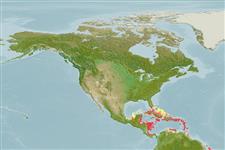
Western Central Atlantic: known only from the Bahamas. Also in Cuba and the Lesser Antilles (Ref. 26938).
Taille / Poids / Âge
Maturité: Lm ? range ? - ? cm
Max length : 5.5 cm SL mâle / non sexé; (Ref. 27742)
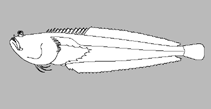
Épines dorsales (Total) : 10; Épines anales: 2; Rayons mous anaux: 32 - 33. Common amongst Dactyloscopidae: Small, elongate fishes. Head usually broad and deep, body tapering and compressed behind. Eyes on top of head, often protrusible; mouth moderate to large, oblique to vertical; upper and/or lower lips with fimbriae; jaw teeth minute, in 2 or more series; no teeth on roof of mouth (vomer and palatines). Opercular opening large, gill membrane free from isthmus; opercles membranous, large, usually overlapping on underside of head, typically fringed above with 2 to 24 fleshy fimbriae. Dorsal fin continuous, with an isolated or semi-isolated anterior finlet, or with 1 to 5 separate anterior rays; dorsal-fin spines 7 to 23; anal-fin spines 2; dorsal and anal fins free or united to caudal fin by fragile membranes; pectoral fins broad-based, usually enlarged in mature males; caudal-fin rays simple or branched; pelvic fins under throat (insertion anterior to pectoral-fin base), with 1 spine and 3 thickened segmented rays; all other rays simple. Head and venter naked, body elsewhere with large cycloid scales (smooth to touch); lateral line high anteriorly, deflecting ventrally behind pectoral fin to continue along middle of side to caudal-fin base where terminal lateral-line scale bears ventrally directed canal. Body coloration, variably pale to strongly pigmented with white, brown, or reddish; some forms with characteristic saddle-like bars crossing back; others plain, mottled, or with indications of lateral stripes. Species distinguished by: dorsal-fin spines usually 10; total dorsal-fin elements 39 to 41 (usually 40); dorsal-fin origin on nape; without a distinct anterior finlet. Segmented anal-fin rays 32 or 33. First preopercular canal branched, with 2 or more distal pores. Posterior naris (a single pore) located on anterior rim of preorbital, adjacent to base of tubiform anterior naris; premaxillary pedicels reach well past rear margins of orbits. Expanded eyestalk not exceptionally long and slender (Ref.52855).
Body shape (shape guide): elongated.
Cycle de vie et comportement reproducteur
Maturité | Reproduction | Frai | Œufs | Fécondité | Larves
Dawson, C.E., 1982. Atlantic sand stargazers (Pisces: Dactyloscopidae), with description of one new genus and seven new species. Bull. Mar. Sci. 32(1):14-85. (Ref. 27742)
Statut dans la liste rouge de l'IUCN (Ref. 130435: Version 2025-2 (Global))
Menace pour l'homme
Harmless
Utilisations par l'homme
Pêcheries: sans intérêt
Outils
Articles particuliers
Télécharger en XML
Sources Internet
Estimations basées sur des modèles
Température préférée (Réf.
123201): 27 - 28.3, mean 27.8 °C (based on 341 cells).
Indice de diversité phylogénétique (Réf.
82804): PD
50 = 0.5000 [Uniqueness, from 0.5 = low to 2.0 = high].
Bayesian length-weight: a=0.00389 (0.00180 - 0.00842), b=3.12 (2.94 - 3.30), in cm total length, based on all LWR estimates for this body shape (Ref.
93245).
Niveau trophique (Réf.
69278): 4.1 ±0.6 se; based on size and trophs of closest relatives
Vulnérabilité de la pêche (Ref.
59153): Low vulnerability (10 of 100).
🛈