Classification / Noms
Noms communs | Synonymes | Catalog of Fishes(Genre, Espèce) | ITIS | CoL | WoRMS | Cloffa
>
Blenniiformes (Blennies) >
Dactyloscopidae (Sand stargazers)
Etymology: Platygillellus: Greek, platys = flat + Theodore Nicolas Gill (1837-1914) researcher of abyssal fishes and systematics (Ref. 45335); smithi: Named after the collector of the holotype, C. Lavett Smith, Curator of Fishes (AMNH).
Eponymy: Clarence Lavett Smith, Jr. (1927–2015) was an American ichthyologist who spent most of his career at the AMNH. Among his many publications was: Fish watching – an outdoor guide to freshwater fishes (1994). (Ref. 128868), visit book page.
Environnement : milieu / zone climatique / profondeur / gamme de distribution
Écologie
marin démersal; profondeur 0 - 8 m (Ref. 27742). Tropical
Western Central Atlantic: Bahamas.
Taille / Poids / Âge
Maturité: Lm ? range ? - ? cm
Max length : 3.4 cm SL mâle / non sexé; (Ref. 27742)
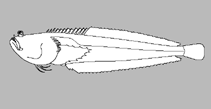
The dorsal finlet is 4-spined, its height about equal to predorsal length), distance between 3rd and 4th dorsal spines approximately equal to the distance between 1st and 3rd. Anal fin rays 22, segmented. Scales 11 - 12 in the straight portion of the lateral line (Ref. 56973).
Cycle de vie et comportement reproducteur
Maturité | Reproduction | Frai | Œufs | Fécondité | Larves
Dawson, C.E., 1982. Atlantic sand stargazers (Pisces: Dactyloscopidae), with description of one new genus and seven new species. Bull. Mar. Sci. 32(1):14-85. (Ref. 27742)
Statut dans la liste rouge de l'IUCN (Ref. 130435: Version 2025-2 (Global))
Menace pour l'homme
Harmless
Utilisations par l'homme
Pêcheries: sans intérêt
Outils
Articles particuliers
Télécharger en XML
Sources Internet
Estimations basées sur des modèles
Indice de diversité phylogénétique (Réf.
82804): PD
50 = 0.5156 [Uniqueness, from 0.5 = low to 2.0 = high].
Bayesian length-weight: a=0.00389 (0.00180 - 0.00842), b=3.12 (2.94 - 3.30), in cm total length, based on all LWR estimates for this body shape (Ref.
93245).
Niveau trophique (Réf.
69278): 3.8 ±0.6 se; based on size and trophs of closest relatives
Vulnérabilité de la pêche (Ref.
59153): Low vulnerability (10 of 100).
🛈