>
Siluriformes (Catfishes) >
Loricariidae (Armored catfishes) > Loricariinae
Etymology: Rineloricaria: Greek, rhinos = nose + Latin, lorica, loricare = cuirass of corslet of leather; 1706 (Ref. 45335).
Ambiente: milieu / zona climatica / distribuzione batimetrica / gamma di distribuzione
Ecologia
; acqua dolce demersale. Temperate
South America: Brazil and Uruguay.
Dimensione / Peso / Età
Maturità: Lm ? range ? - ? cm
Max length : 12.8 cm SL maschio/sesso non determinato; (Ref. 75788)
Breve descrizione
Chiavi di identificazione | Morfologia | Morfometria
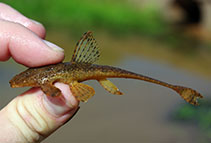
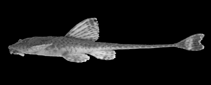
It possesses the characters of the sandy group and within the species sandy group, it can be diagnosed by the following characters: elongate naked area at tip of snout reaching the most anterior pore of the infraorbital sensory canal (vs. oval naked area at tip of snout, not reaching the most anterior pore of the infraorbital sensory canal in Rineloricaria quadrensis, Rineloricaria misionera, and Rineloricaria strigilata b); plain, light brown background color (vs. with numerous dark and vermiculated spots on a light brown background in Rineloricaria strigilata); dorsal unbranched caudal-fin ray not prolonged (vs. dorsal unbranched caudal-fin ray produced as a short filament in Rineloricaria catamarcencis); usually three series of plates between the lateral abdominal plates (vs. four of five series in Rineloricaria catamarcensis and Rineloricaria felipponei); deeper body, depth at anal-fin origin 7.9-9.4% SL (vs. 6.0-7.4% SL in Rineloricaria longicauda in specimens above 10 cm SL); and comparatively larger plates covering the pectoral girdle, usually 5-6 plates transversally and usually three series of plates between the lateral abdominal plates (vs. many small plates covering the pectoral girdle, usually over 15 platelets, and four of five series of plates between the lateral abdominal plates in Rineloricaria pareiacantha and Rineloricaria thrissoceps (Ref. 75788).
Body shape (shape guide): elongated.
Facultative air-breathing in the genus (Ref. 126274); Found in watercourses with slow to fast flow, clear to brown water, and rocky, sandy, or muddy bottom (Ref. 75788). Adults usually inhabit sandy bottom while young individuals prefer the leaves of marginal vegetation (Ref. 75788).
Ciclo vitale e comportamento di accoppiamento
Maturità | Riproduzione | Deposizione | Uova | Fecondità | Larve
Rodriguez, M.S. and R.E. Reis, 2008. Taxonomic review of Rineloricaria (Loricariidae: Loricariinae) from the Laguna dos Patos drainage, Southern Brazil, with the descriptions of two new species and the recognition of two species groups. Copeia 2008(2):333-349. (Ref. 75788)
Stato della Lista Rossa IUCN (Ref. 130435: Version 2025-2 (Global))
Minaccia per l'uomo
Harmless
Usi umani
Pesca: di nessun interesse
Strumenti
Rapporti speciali
Scarica XML
Fonti Internet
Stime basate su modelli
Indice di diversità filogenetica (Fonte Biblio.
82804): PD
50 = 0.5000 [Uniqueness, from 0.5 = low to 2.0 = high].
Bayesian length-weight: a=0.00479 (0.00285 - 0.00804), b=3.18 (3.04 - 3.32), in cm total length, based on LWR estimates for this species & Genus-body shape (Ref.
93245).
Livello trofico (Fonte Biblio.
69278): 2.5 ±0.2 se; based on size and trophs of closest relatives
Resilienza (Fonte Biblio.
120179): Medio, tempo minimo di raddoppiamento della popolazione 1.4 - 4.4 anni (Preliminary K or Fecundity.).
Vulnerabilità della pesca (Ref.
59153): Low vulnerability (10 of 100).
🛈