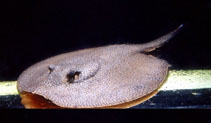
Elasmobranquios (tiburones y rayas) (sharks and rays) >
Myliobatiformes (Stingrays) >
Potamotrygonidae (River stingrays) > Potamotrygoninae
Etymology: Potamotrygon: Greek, potamos = river + Greek, trygon = a sting ray (Ref. 45335).
Eponymy: Alcide Charles Victor Dessalines d’Orbigny (1802–1857) was a traveller, collector, illustrator and naturalist. [...] (Ref. 128868), visit book page.
More on author: Castelnau.
Taxonomic Remarks
A widespread species that may require subdivision. Rosa (1985a) recognizes Potamotrygon dumerilli (Castelnau 1855) and Potamotrygon humerosus Garman 1913 as distinct species, but evidence given is meager. Larger specimens may weigh close to five kg. Reproductive biology studied by Lasso et al. (1997a) in Venezuela; males achieve sexual maturity at 23 cm DL and females at 18.5 cm DL, and females give birth to up to two pups during any time of year. Food consists of fishes, insects and crustaceans. Additional references: Bertin (1939), Sérét & McEachran (1986), Compagno & Cook (1995), Planquette et al. (1996).
Entorno: milieu / zona climática / rango de profundidad / gama de distribución
Ecología
; agua dulce bentopelágico; pH range: 6.8 - 7.5. Tropical; 24°C - 26°C (Ref. 12468)
South America: Widespread in Amazon and Orinoco River basins and in river systems in Suriname, Guyana and French Guiana.
Tamaño / Peso / Edad
Madurez: Lm ? range ? - ? cm
Max length : 35.0 cm WD macho / no sexado; (Ref. 27749); 32.5 cm WD (female); peso máximo publicado: 1.4 kg (Ref. 27749); peso máximo publicado: 1.4 kg
Occurs in stream swamps, floodplain lakes and artificial lagoons. Feeds mainly on insects and benthic crustaceans (Ref. 27749).
Ciclo vital y comportamiento de apareamiento
Madurez | Reproducción | Puesta | Huevos | Fecundidad | Larva
Lasso, C.A., A. Rial B. and O. Lasso-Alcalá., 1997. Notes on the biology of the freshwater stingrays Paratrygon aiereba (Müller & Henle, 1841) and Potamotrygon orbignyi (Castelnau, 1855) (Chondrichthyes: Potamotrygonidae) in the Venezuelan Llanos. aqua, J. Ichthyol. Aquat. Biol. 2(3):39-52. (Ref. 27749)
Situación en la Lista Roja de la UICN (Ref. 130435: Version 2025-2 (Global))
Amenaza para el ser humano
Harmless
Usos humanos
Herramientas
Informes especiales
Descargar XML
Fuentes de Internet
Estimaciones basadas en modelos
Índice de diversidad filogenética (Referencia
82804): PD
50 = 0.5000 [Uniqueness, from 0.5 = low to 2.0 = high].
Bayesian length-weight: a=0.01000 (0.00244 - 0.04107), b=3.04 (2.81 - 3.27), in cm total length, based on all LWR estimates for this body shape (Ref.
93245).
Nivel trófico (Referencia
69278): 3.2 ±0.43 se; based on food items.
Resiliencia (Referencia
120179): Muy bajo, población duplicada en un tiempo mínimo superior a 14 años (Assuming Fec <10).
Vulnerabilidad pesquera (Ref.
59153): High vulnerability (58 of 100).
🛈