>
Lophiiformes (Anglerfishes) >
Oneirodidae (Dreamers)
Etymology: Lasiognathus: Greek, 'lasios' = hairy or wooly + Greek, 'gnathos' = jaw (with reference to the huge number of long teeth of the upper jaw) ( Ref. 86949).
Eponymy: Dr Charles William Beebe (1877–1962) was an American naturalist, ornithologist, marine biologist, entomologist, explorer and author. [...] (Ref. 128868), visit book page.
More on authors: Regan & Trewavas.
Environnement : milieu / zone climatique / profondeur / gamme de distribution
Écologie
marin bathypélagique; profondeur 0 - 1100 m (Ref. 27827). Deep-water
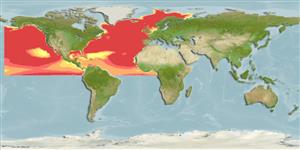
Eastern Central Pacific: Hawaii. Atlantic Ocean: Madeira and Bermuda.
Taille / Poids / Âge
Maturité: Lm ? range ? - ? cm
Max length : 11.5 cm TL (female)
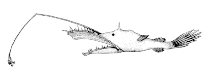
Rayons mous dorsaux (Total) : 6 - 7; Rayons mous anaux: 4 - 5. Escal bulb without membranous anterior crest. Distal escal appendage compressed, transversely fan-shaped, bearing three bony escal hooks along posterior margin, without elongate prolongation emerging from bases of escal hooks. Posterior escal appendage cylindrical, tapering to a point (Ref 27827). Length of illicium 43-44%SL in small specimens, 47-50%SL in large specimens (8 to 11.2 cm); posterior escal appendage 0.5-2.5%SL, emerging from below escal pore; thin edge of distal appendage behind and between bases of escal hooks more or less folded; length of distal appendage, measured from surface of escal bulb to bases of escal hooks, 1.3-2.8% SL (Ref. 86949).
Body shape (shape guide): short and / or deep.
A piscivore, feeding occasionally on invertebrates (Ref. 27828).
Cycle de vie et comportement reproducteur
Maturité | Reproduction | Frai | Œufs | Fécondité | Larves
Bertelsen, E. and T.W. Pietsch, 1996. Revision of the ceratioid anglerfish genus Lasiognathus (Lophiiformes: Thaumatichthyidae), with the description of a new species. Copeia 1996(2):401-409. (Ref. 27827)
Statut dans la liste rouge de l'IUCN (Ref. 130435: Version 2025-2 (Global))
Menace pour l'homme
Harmless
Utilisations par l'homme
Outils
Articles particuliers
Télécharger en XML
Sources Internet
Estimations basées sur des modèles
Température préférée (Réf.
123201): 0.8 - 14.9, mean 4.9 °C (based on 1126 cells).
Indice de diversité phylogénétique (Réf.
82804): PD
50 = 0.5156 [Uniqueness, from 0.5 = low to 2.0 = high].
Bayesian length-weight: a=0.01995 (0.00906 - 0.04395), b=3.01 (2.83 - 3.19), in cm total length, based on all LWR estimates for this body shape (Ref.
93245).
Niveau trophique (Réf.
69278): 4.0 ±0.63 se; based on food items.
Résilience (Réf.
120179): Haut, temps minimum de doublement de population inférieur à 15 mois (Preliminary K or Fecundity.).
Vulnérabilité de la pêche (Ref.
59153): Low vulnerability (10 of 100).
🛈