Taxonomic Remarks
No recent work, see Günther, 1864:330, for description.
Ambiente: milieu / zona climática / intervalo de profundidade / gama de distribuição
Ecologia
; Água doce bentopelágico. Tropical
South America: known from the río Pastaza, río Marañon drainage, and upper río Amazonas basin, Ecuador.
Tamanho / Peso / Idade
Maturidade: Lm ? range ? - ? cm
Max length : 16.8 cm SL macho/indeterminado; (Ref. 38376)
Descrição breve
Chaves de identificação | Morfologia | Morfometria
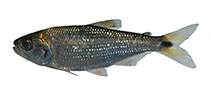
Raios dorsais moles (total) : 8; Raios anais moles: 24 - 28; Vértebras: 40 - 43. This species is distinguished from most of its congeners by the number of branched anal-fin rays (24-28 vs. 15-24 or 28-34); differs from species sharing similar lateral line counts in the following: from H. boquiae by the number of scale rows above and below lateral line (8 and 6 vs. 6-7 and 4-5 respectively), and by the number of predorsal scales (15-17 vs. 12-15); from H. brevispini and H. cairoense by the number of scale rows above lateral line (8 vs. 6-7); from H. dariensis, H. divisorensis, H. surinamensis and H. taeniurus by the number of lateral line scales (42-45 vs. 39-42); from H. huambonicus by the number of caudal peduncle scales (16 vs. 18-20), head length (20.9-22.9 vs. 22.0-26.0% SL), and upper jaw length (43.7-45.6 vs. 45.2-52.6% HL); from H. inambari by the number of scales along anal-fin base scale sheath (14-23 vs. 6-10); from H. jabonero by the number of caudal peduncle scales (16 vs. 14), and number of scale rows below lateral line (6 vs. 4-5); from H. jelskii by the number of maxillary teeth (7-10 vs. 8-17), and by the size of humeral spot (6-7 vs. 7-9 horizontal series of scales); from H. metae by the number of cusps of second tooth of premaxillary inner row teeth (5 vs. 7), caudal peduncle length (14.4-16.6 vs. 11.1-14.8% SL), and head length (20.9-22.9 vs. 22.1-25.0% SL); from H. quindos by the number of scale rows above and below of lateral line (8 and 6 vs. 6-7 and 4-5); from H. rafaelense by the number of predorsal scales (15-17 vs. 10-13), orbital diameter (29.5-34.1 vs. 36.6-43.6% HL), and interorbital width (32.1-35.3 vs. 34.7-41.5% HL); from H. raqueliae and H. yacopiae by the number of predorsal scales (15-17 vs. 10-14), and by the number of cusps of first maxillary tooth (3 vs. 5 in H. raqueliae); from H. surinamensis and H. divisorensis by the absence of a wide black asymmetrical spot covering base of caudal-fin rays; H. dariensis by the absence of pigment in the distal tip of rays just above and below to middle caudal-fin rays (Ref. 85819).
Body shape (shape guide): elongated; Cross section: compressed.
Ciclo de vida e comportamento de acasalamento
Maturidade | Reprodução | Desova | Ovos | Fecundidade | Larvas
Bertaco, V.A. and L.R. Malabarba, 2010. A review of the Cis-Andean species of Hemibrycon Günther (Teleostei: Characiformes: Characidae: Stevardiinae), with description of two new species. Neotrop. Ichthyol. 8(4):737-770. (Ref. 85819)
Categoria na Lista Vermelha da IUCN (Ref. 130435: Version 2025-2 (Global))
Ameaça para o homem
Harmless
Utilização humana
Ferramentas
Relatórios especiais
Descarregue XML
Fontes da internet
Estimativas baseadas em modelos
Índice de diversidade filogenética (Ref.
82804): PD
50 = 0.5000 [Uniqueness, from 0.5 = low to 2.0 = high].
Bayesian length-weight: a=0.00776 (0.00322 - 0.01872), b=3.13 (2.92 - 3.34), in cm total length, based on LWR estimates for this (Sub)family-body shape (Ref.
93245).
Nível Trófico (Ref.
69278): 3.0 ±0.4 se; based on size and trophs of closest relatives
Vulnerabilidade da pesca (Ref.
59153): Low vulnerability (11 of 100).
🛈