Taxonomic Remarks
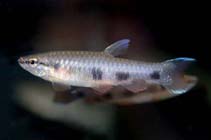
P. spilota has been collected recently in the Iquitos region. It is another of the P. brevis group, easily recognized by the four dark blotches on the body, its long fins with black borders, and black markings on the anal fin as well as the dorsal fin. Eschmeyer, 1998:1588; Ortega and Vari, 1986:11.
Meio ambiente: milieu / Zona climática / intervalo de profundidade / faixa de distribuição
Ecologia
; Água doce bentopelágico; pH range: 5.8 - 7.0; dH range: ? - 15. Tropical; 23°C - 26°C (Ref. 2059)
South America: upper Amazon River Basin in Peru.
Tamanho / Peso / Idade
Maturidade: Lm ? range ? - ? cm
Max length : 7.0 cm SL macho/indeterminado; (Ref. 37104)
Ciclo de vida ou comportamento de acasalamento
Maturidade | Reprodução | Desova | Ovos | Fecundidade | Larvas
Ortega, H. and R.P. Vari, 1986. Annotated checklist of the freshwater fishes of Peru. Smithson. Contrib. Zool. (437):1-25. (Ref. 6329)
Status na Lista Vermelha da UICN (Ref. 130435: Version 2025-2 (Global))
Ameaça para os humanos
Harmless
Uso pelos humanos
Pescarias: de interesse potencial
Ferramentas
Relatórios especiais
Baixar XML
Fontes da internet
Estimativas baseadas em modelos
Índice de diversidade filogenética (Ref.
82804): PD
50 = 0.5000 [Uniqueness, from 0.5 = low to 2.0 = high].
Bayesian length-weight: a=0.00646 (0.00280 - 0.01488), b=3.13 (2.93 - 3.33), in cm total length, based on LWR estimates for this (Sub)family-body shape (Ref.
93245).
Nível Trófico (Ref.
69278): 3.3 ±0.4 se; based on size and trophs of closest relatives
Vulnerabilidade da pesca (Ref.
59153): Low vulnerability (10 of 100).
🛈