>
Synbranchiformes (Spiny eels) >
Mastacembelidae (Spiny eels)
Etymology: Mastacembelus: Greek, mastax, -agos = bite + Greek, emballo = to throw oneself (Ref. 45335); robertsi: Named for Tyson R. Roberts who collected part of the typematerial and who first suggested that this species might well be new to science (Ref. 28147).
Eponymy: Dr Tyson Royal Roberts (d: 1940) is an American naturalist and evolutionary biologist who has devoted most of his life to studying biodiversity, particularly that of fishes, throughout the tropics. [...] (Ref. 128868), visit book page.
Environnement : milieu / zone climatique / profondeur / gamme de distribution
Écologie
; eau douce benthopélagique. Tropical; 6°N - 7°S
Africa: lower Congo River and Pool Malebo in Democratic Republic of the Congo, and lower Kotto and Bomu rivers (Ubangui drainage, middle Congo River basin) in Central African Republic; also reported from Bangui fish market in Central African Republic (Ref. 28147).
Taille / Poids / Âge
Maturité: Lm ? range ? - ? cm
Max length : 33.8 cm SL mâle / non sexé; (Ref. 84205)
Description synthétique
Clés d'identification | Morphologie | Morphométrie
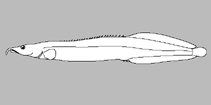
Épines dorsales (Total) : 22 - 26; Rayons mous dorsaux (Total) : 66 - 92; Épines anales: 1 - 2; Rayons mous anaux: 63 - 92; Vertèbres: 74 - 82. Can be distinguished from other African mastacembelid species by following combination of characters: small eyes, anterior border of first dorsal spine situated before, above, or just behind posterior edge of pectoral fin; generally the color pattern is uniform (Ref. 28147).
Body shape (shape guide): eel-like.
Collected mostly from the rapids. For specimens of the Lower Congo River basin (mainstream), water temperature was recorded at a range of 24.7-29.0°C, air temperature at 23.3-30.0°C, D.O. 8.0 mg/l, and pH 7.0-7.5 (Ref. 28147).
Cycle de vie et comportement reproducteur
Maturité | Reproduction | Frai | Œufs | Fécondité | Larves
Vreven, E.J. and G.G. Teugels, 1996. Description of a new mastacembelid species (Synbranchiformes; Mastacembelidae) from the Zaïre River basin in Africa. Copeia 1996(1):130-139. (Ref. 28147)
Statut dans la liste rouge de l'IUCN (Ref. 130435: Version 2025-2 (Global))
Menace pour l'homme
Harmless
Utilisations par l'homme
Outils
Articles particuliers
Télécharger en XML
Sources Internet
Estimations basées sur des modèles
Indice de diversité phylogénétique (Réf.
82804): PD
50 = 0.5000 [Uniqueness, from 0.5 = low to 2.0 = high].
Bayesian length-weight: a=0.00269 (0.00129 - 0.00562), b=2.94 (2.76 - 3.12), in cm total length, based on LWR estimates for this (Sub)family-body shape (Ref.
93245).
Niveau trophique (Réf.
69278): 3.8 ±0.6 se; based on size and trophs of closest relatives
Résilience (Réf.
120179): Milieu, temps minimum de doublement de population : 1,4 à 4,4 années (Preliminary K or Fecundity.).
Vulnérabilité de la pêche (Ref.
59153): Low to moderate vulnerability (31 of 100).
🛈