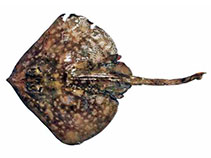
Elasmobranchi (squali e razze) (sharks and rays) >
Rajiformes (Skates and rays) >
Rajidae (Skates)
Etymology: Hongeo: Name refers to the Korean common name for skates, 'hong-eo'.’; koreanus: Named after its type locality (Ref. 26574).
Ambiente: milieu / zona climatica / distribuzione batimetrica / gamma di distribuzione
Ecologia
marino demersale; distribuzione batimetrica 30 - 180 m (Ref. 81217). Temperate
Northwest Pacific: southwestern coast of the Korean Peninsula.
Dimensione / Peso / Età
Maturità: Lm ? range ? - ? cm
Max length : 76.0 cm TL maschio/sesso non determinato; (Ref. 26574); 73.5 cm TL (female)
Breve descrizione
Chiavi di identificazione | Morfologia | Morfometria
This species is characterized by two derived character states: rostral cartilage continuous with the neurocranium and stout proximally, but very slender and uncalcified distally; and a broad anterior fontanelle, extending forward onto the basal part of rostral cartilage, slightly beyond the leading edge of nasal capsules. Other characters that distinguished this species are the following: the dorsal surface of tail of both sexes with a row of distinct thorns along midline; most thorns are directed anteriorly; middle of dorsal surface of disc with a pair of longitudinally elongated black blotches with undulated contours; three groups of outer buccal ampullae and tubules; three groups of nasal ampullae and tubules; ventral surface with hyoidean ampullae and tubules extending posteriorly past cloaca; rostral shaft is narrow with filamentous cartilage at the base; scapulocoracoid comparatively short and high with dorsoventrally elliptical anterior fenestra and expanded postventral fenestra; external margin of mesopterygium of pectoral fin slightly undulated, not sinuous nor fused with pectoral radials; with clasper component eperon and pent (Ref. 81217).
Body shape (shape guide): other.
Oviparous (Ref. 50449, 81217). Eggs have horn-like projections on the shell (Ref. 205). Maximum length for female from Ref. 26574.
Ciclo vitale e comportamento di accoppiamento
Maturità | Riproduzione | Deposizione | Uova | Fecondità | Larve
Oviparous, paired eggs are laid. Embryos feed solely on yolk (Ref. 50449).
Jeong, C.-H. and T. Nakabo, 1997. Raja koreana, a new species of skate (Elasmobranchii, Rajoidei) from Korea. Ichthyol. Res. 44(4):413-420. (Ref. 26574)
Stato della Lista Rossa IUCN (Ref. 130435: Version 2025-2 (Global))
Minaccia per l'uomo
Harmless
Usi umani
Strumenti
Rapporti speciali
Scarica XML
Fonti Internet
Stime basate su modelli
Indice di diversità filogenetica (Fonte Biblio.
82804): PD
50 = 1.0000 [Uniqueness, from 0.5 = low to 2.0 = high].
Bayesian length-weight: a=0.00302 (0.00141 - 0.00645), b=3.24 (3.07 - 3.41), in cm total length, based on LWR estimates for this (Sub)family-body shape (Ref.
93245).
Livello trofico (Fonte Biblio.
69278): 3.8 ±0.6 se; based on size and trophs of closest relatives
Resilienza (Fonte Biblio.
120179): Basso, tempo minimo di raddoppiamento della popolazione 4.5 - 14 anni (Fec assumed to be <100).
Vulnerabilità della pesca (Ref.
59153): Moderate to high vulnerability (50 of 100).
🛈