>
Gobiiformes (Gobies) >
Gobiidae (Gobies) > Sicydiinae
Etymology: Stiphodon: Greek, stiphos, -eos, -oys = mass + Greek, odous = teeth (Ref. 45335).
More on author: Herre.
Ambiente: milieu / zona climatica / distribuzione batimetrica / gamma di distribuzione
Ecologia
marino; acqua dolce; salmastro benthopelagico; amfidromo. Subtropical
Northwest Pacific: tropical and subtropical; Japan, Taiwan, Malaysia, Philippines and the mainland of South China. Considered to be of conservation concern in subtropical Asia (Ref. 82688).
Dimensione / Peso / Età
Maturità: Lm ? range ? - ? cm
Max length : 5.0 cm TL maschio/sesso non determinato; (Ref. 28731)
Breve descrizione
Chiavi di identificazione | Morfologia | Morfometria
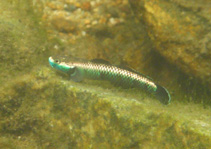
Spine dorsali (totale) : 7; Raggi dorsali molli (totale) : 9; Spine anali: 1; Raggi anali molli: 10. Sexual dimorphism obvious; mature male with body, snout and cheek iridescent green/ blue/ purple (depending on viewing angle and the age and status of the fish); first dorsal fin not elongated/ filamentous, dorsal fins with narrow red margin while female body has white/ pale buff with two obvious transverse stripes (Ref. 28731, 43239).
Body shape (shape guide): elongated.
Adults inhabit clear streams and mainly feed on epiphyte and biofilm on rocks in the wild. Due to its possible amphidromous nature, as known to occur with its congeners (adults live and breed in freshwater streams; larvae hatched drift downstream and develop in marine environments; juveniles return to freshwater streams), blockage of the migration pathway (e.g. construction of dam or culvert in streams) would cause a significant impact on this species. Ensuring no net loss of habitat, keeping the natural stream flow and maintaining the stream-ocean corridor are all essential for preserving this species (in reference to its congeners; see Ref. 82682, 82684, 82689, 82690). Collection conducted by aquarium hobbyists (both private and commercial) also poses a serious threat to Stiphodon species in some regions (Ref. 82684) and this kind of activity should be strictly controlled (Ref. 82694).
Ciclo vitale e comportamento di accoppiamento
Maturità | Riproduzione | Deposizione | Uova | Fecondità | Larve
Watson, R.E and I.-S. Chen, 1998. Freshwater gobies of the genus Stiphodon from Japan and Taiwan (Teleostei: Gobiidae: Sicydiini). aqua, J. Ichthyol. Aquat. Biol. 3(2):55-66. (Ref. 28731)
Stato della Lista Rossa IUCN (Ref. 130435: Version 2025-2 (Global))
Minaccia per l'uomo
Harmless
Usi umani
Pesca: di nessun interesse
Strumenti
Rapporti speciali
Scarica XML
Fonti Internet
Stime basate su modelli
Indice di diversità filogenetica (Fonte Biblio.
82804): PD
50 = 0.5000 [Uniqueness, from 0.5 = low to 2.0 = high].
Bayesian length-weight: a=0.00389 (0.00180 - 0.00842), b=3.12 (2.94 - 3.30), in cm total length, based on all LWR estimates for this body shape (Ref.
93245).
Resilienza (Fonte Biblio.
120179): Alto, tempo minimo di raddoppiamento della popolazione meno di 15 mesi (Preliminary K or Fecundity.).
Vulnerabilità della pesca (Ref.
59153): Low vulnerability (10 of 100).
🛈