>
Pleuronectiformes (Flatfishes) >
Pleuronectidae (Righteye flounders) > Atheresthinae
Etymology: Atheresthes: Greek, atheres = spike + The name of Astyanax, Hector´s son in the Greek mithology (Ref. 45335).
Eponymy: Dr Barton Warren Evermann (1853–1932) was a schoolteacher (1876–1886) and a student at Indiana University, where he was awarded his bachelor’s degree (1886), master’s (1888) and doctorate (1891). [...] (Ref. 128868), visit book page.
More on authors: Jordan & Starks.
Entorno: milieu / zona climática / rango de profundidad / gama de distribución
Ecología
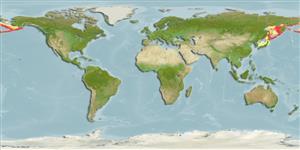
marino demersal; rango de profundidad 20 - 1200 m (Ref. 50550). Temperate; 66°N - 35°N, 130°E - 153°W (Ref. 6793)
North Pacific: Sea of Japan and the Sea of Okhotsk north to the Anadyr Gulf, through the eastern Bering Sea to the Aleutian Islands and the Shelikof Strait in Alaska.
Tamaño / Peso / Edad
Madurez: Lm ? range ? - ? cm
Max length : 100.0 cm SL macho / no sexado; (Ref. 559); common length : 54.0 cm TL macho / no sexado; (Ref. 56527); peso máximo publicado: 8.5 kg (Ref. 56527); edad máxima reportada: 33 años (Ref. 55701)
Descripción breve
Claves de identificación | Morfología | Morfometría
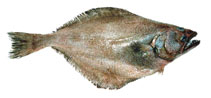
Espinas dorsales (total) : 0; Radios blandos dorsales (total) : 98 - 116; Espinas anales: 0; Radios blandos anales: 76 - 94. Mouth very large; gill rakers slender; caudal fin strong and lunate (Ref. 559).
Body shape (shape guide): short and / or deep.
Ciclo vital y comportamiento de apareamiento
Madurez | Reproducción | Puesta | Huevos | Fecundidad | Larva
Vinnikov, K.A., R.C. Thomson and T.A. Munroe, 2018. Revised classification of the righteye flounders (Teleostei: Pleuronectidae) based on multilocus phylogeny with complete taxon sampling. Molecular phylogenetics and evolution, 125:147-162. (Ref. 122998)
Situación en la Lista Roja de la UICN (Ref. 130435: Version 2025-2 (Global))
Amenaza para el ser humano
Harmless
Usos humanos
Pesquerías: comercial
Herramientas
Informes especiales
Descargar XML
Fuentes de Internet
Estimaciones basadas en modelos
Temperatura preferida (Referencia
123201): 0.7 - 5.4, mean 1.7 °C (based on 287 cells).
Índice de diversidad filogenética (Referencia
82804): PD
50 = 0.7500 [Uniqueness, from 0.5 = low to 2.0 = high].
Bayesian length-weight: a=0.00759 (0.00559 - 0.01029), b=3.03 (2.94 - 3.12), in cm total length, based on LWR estimates for this species (Ref.
93245).
Nivel trófico (Referencia
69278): 4.3 ±0.2 se; based on diet studies.
Generation time: 13.7 ( na - na) years. Estimated as median ln(3)/K based on 2
growth studies.
Resiliencia (Referencia
120179): Bajo, población duplicada en un tiempo mínimo de 4.5-14 años (Assuming tm>4; tmax=33; K=0.08).
Prior r = 0.18, 95% CL = 0.12 - 0.27, Based on 2 full stock assessments.
Vulnerabilidad pesquera (Ref.
59153): High vulnerability (64 of 100).
🛈
Vulnerabilidad climática (Ref.
125649): Moderate vulnerability (44 of 100).
🛈
Nutrientes (Ref.
124155): Calcium = 20.2 [8.0, 35.3] mg/100g; Iron = 0.244 [0.123, 0.466] mg/100g; Protein = 17.2 [15.9, 18.6] %; Omega3 = 0.375 [0.180, 0.771] g/100g; Selenium = 26.7 [13.1, 59.3] μg/100g; VitaminA = 10.3 [2.3, 45.7] μg/100g; Zinc = 0.281 [0.186, 0.427] mg/100g (wet weight);