>
Siluriformes (Catfishes) >
Plotosidae (Eeltail catfishes)
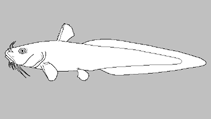
Etymology: Neosiluroides: Greek, neos = new + Greek, silouros = cat fish; cooperensis: Named for its known distribution, Cooper Creek.
Entorno: milieu / zona climática / rango de profundidad / gama de distribución
Ecología
; agua dulce demersal. Subtropical
Oceania: Cooper Creek system, part of the Lake Eyre drainage basin.
Tamaño / Peso / Edad
Madurez: Lm ? range ? - ? cm
Max length : 46.0 cm SL macho / no sexado; (Ref. 44894); common length : 23.0 cm SL macho / no sexado; (Ref. 44894)
Usually found in larger, more permanent waterholes with an earth and clay substrate (Ref. 27663, 44894). Significant flow occurs only after severe rainfall events, water is typically very turbid. Very aggressive towards other fishes, particularly in captivity. Feeds on gastropods and crustaceans. Has the largest egg size (3-4 mm) and lowest fecundity (about 1000 eggs per spawning) per unit length of any plotosid catfish in Australia (Ref. 44894).
Ciclo vital y comportamiento de apareamiento
Madurez | Reproducción | Puesta | Huevos | Fecundidad | Larva
Allen, G.R. and M.N. Feinberg, 1998. Descriptions of a new genus and four new species of freshwater catfishes (Plotosidae) from Australia. aqua, J. Ichthyol. Aquat. Biol. 3(1):9-18. (Ref. 27663)
Situación en la Lista Roja de la UICN (Ref. 130435: Version 2025-2 (Global))
Amenaza para el ser humano
Harmless
Usos humanos
Herramientas
Informes especiales
Descargar XML
Fuentes de Internet
Estimaciones basadas en modelos
Índice de diversidad filogenética (Referencia
82804): PD
50 = 1.0000 [Uniqueness, from 0.5 = low to 2.0 = high].
Bayesian length-weight: a=0.00468 (0.00210 - 0.01040), b=3.06 (2.86 - 3.26), in cm total length, based on LWR estimates for this (Sub)family-body shape (Ref.
93245).
Nivel trófico (Referencia
69278): 3.4 ±0.58 se; based on food items.
Resiliencia (Referencia
120179): Medio, población duplicada en un tiempo mínimo de 1.4-4.4 años (Preliminary K or Fecundity.).
Vulnerabilidad pesquera (Ref.
59153): Moderate vulnerability (42 of 100).
🛈