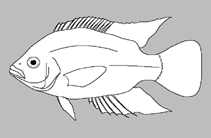
Classification / Noms
Noms communs | Synonymes | Catalog of Fishes(Genre, Espèce) | ITIS | CoL | WoRMS | Cloffa
>
Cichliformes (Cichlids, convict blennies) >
Cichlidae (Cichlids) > Pseudocrenilabrinae
Etymology: Haplochromis: Greek, Haploos = single + Greek, chromis = a fish, perhaps a perch (Ref. 45335).
Taxonomic Remarks
Name is a junior primary homonym of Haplochromis cyaneus Trewavas, 1935. According to Article 23.9.5 of the International Code of Zoological Nomenclature a replacement name is not needed (MRAC pers. comm.). This species is uncertain in Haplochromis in Eschmeyer (CofF ver. Jul. 2010: Ref. 84883).
Environnement : milieu / zone climatique / profondeur / gamme de distribution
Écologie
; eau douce benthopélagique. Tropical
Africa: eastern Lake Victoria, Tanzania (Ref. 27668).
Taille / Poids / Âge
Maturité: Lm ? range ? - ? cm
Max length : 10.7 cm SL mâle / non sexé; (Ref. 27668)
Description synthétique
Clés d'identification | Morphologie | Morphométrie
Épines dorsales (Total) : 16 - 17; Rayons mous dorsaux (Total) : 9 - 11; Épines anales: 3; Rayons mous anaux: 8 - 10; Vertèbres: 30 - 32.
Body shape (shape guide): fusiform / normal.
Restricted to rocky substrates; lives and feeds exclusively on the surface of rocky substrates, usually exposed to wave action; never observed or collected in crevices, and rarely in sheltered embayment; feeds predominantly on Chironomid larvae that live among algal filaments on the surface of rocks; polygynous female mouth brooder with maternal parental care (Ref. 27668).
Cycle de vie et comportement reproducteur
Maturité | Reproduction | Frai | Œufs | Fécondité | Larves
A polygynous female mouth brooder with maternal parental care. In the aquarium, females incubate eggs and larvae for about 15 days before they first release them and guards the fry for another 15 days.
Seehausen, O., E. Lippitsch, N. Bouton and H. Zwennes, 1998. Mbipi, the rock-dwelling cichlids of Lake Victoria: description of three new genera and fifteen new species (Teleostei). Ichthyol. Explor. Freshwat. 9(2):129-228. (Ref. 27668)
Statut dans la liste rouge de l'IUCN (Ref. 130435: Version 2025-2 (Global))
Menace pour l'homme
Harmless
Utilisations par l'homme
Outils
Articles particuliers
Télécharger en XML
Sources Internet
Estimations basées sur des modèles
Indice de diversité phylogénétique (Réf.
82804): PD
50 = 0.5000 [Uniqueness, from 0.5 = low to 2.0 = high].
Bayesian length-weight: a=0.01445 (0.00671 - 0.03113), b=2.99 (2.82 - 3.16), in cm total length, based on LWR estimates for this (Sub)family-body shape (Ref.
93245).
Niveau trophique (Réf.
69278): 2.6 ±0.26 se; based on food items.
Résilience (Réf.
120179): Haut, temps minimum de doublement de population inférieur à 15 mois (Preliminary K or Fecundity.).
Vulnérabilité de la pêche (Ref.
59153): Low vulnerability (10 of 100).
🛈