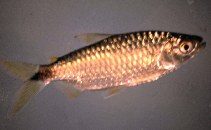
Ambiente: milieu / zona climatica / distribuzione batimetrica / gamma di distribuzione
Ecologia
; acqua dolce demersale; pH range: 6.0 - 6.5; dH range: 4 - 18; potamodromo (Ref. 51243). Tropical; 22°C - 26°C (Ref. 1672); 23°S - 31°S
Africa: Mono River in Togo to Nipoué River in Liberia (Ref. 2880, 81279). Widely distributed in the Congo River basin (Ref. 42019). Also in the middle Zambezi (Ref. 95585), lower Zambezi, Wami River in Tanzania to Pongolo River in South Africa; Lakes Malawi, Rukwa, Rufiji and Ruvuma; on the western coast in the Quanza and the Nyanga, Tanganyika tributaries, Lake Kariba, Cunene River (Ref. 5331).
Lunghezza alla prima maturità / Dimensione / Peso / Età
Maturità: Lm 9.3 range ? - ? cm
Max length : 19.8 cm TL maschio/sesso non determinato; (Ref. 2880); peso massimo pubblicato: 300.00 g (Ref. 7248); Età massima riportata: 5 anni (Ref. 7248)
Spine anali: 0; Raggi anali molli: 14 - 18. Diagnosis: parietal fontanella absent in adults and porelinke in juveniles, disappearing with growth; snout short, comprised over three times in head length; dorsal-fin origin at same level as, or scarcely behind, pelvic-fin insertions; head narrow; adults medium-sized; sexual dimorphism affecting anal-fin shape in adult males; no band or spots on sides; caudal fin red, not black-edged; 4.5 scales between lateral line and dorsal fin; 21-31 lateral line scales; 11-16 anal fin branched rays; 8/8 premaxillary teeth; 16-20 gill rakers in lower part of first branchial arch (Ref. 2880, 81279).
Body shape (shape guide): fusiform / normal.
Found in shallow and sheltered waters of swampy bays. Generally restricted to shallow waters where they may be found in various habitats such as over sand, rock or, less frequently, in aquatic weed beds (Ref. 13337). Common in shallow vegetated areas (Ref. 4967). Also found in large rivers and floodplain pans and lagoons. Feeds on insects, tiny fishes, vegetable matters (Ref. 5595) and crustaceans (Ref. 13337). Main predator is the tigerfish (Ref. 7248). Breeds in summer, migrating to spawning sites after rains. Migrates to tributary rivers and floodplains when the rivers come down in spate (Ref. 13337). Known to mass at river mouths while waiting for suitable conditions to trigger off the breeding migrations upstream (Ref. 13337). Used as live bait for tigerfish and large catfish (Ref. 13337). Affinities: B. carolinae, with lateral stripe; B. nigricauda with wide black margin on caudal fin.
Ciclo vitale e comportamento di accoppiamento
Maturità | Riproduzione | Deposizione | Uova | Fecondità | Larve
Assumed to be the same as Arnoldichthys spilopterus.
Paugy, D., 1990. Characidae. p. 195-236. In C. Lévêque, D. Paugy and G.G. Teugels (eds.) Faune des poissons d'eaux douces et saumâtres de l'Afrique de l'Ouest. Tome I. Coll. Faune Tropicale n° XXVIII. Musée Royal de l'Afrique Centrale, Tervuren et O.R.S.T.O.M., Paris, 384 p. (Ref. 2880)
Stato della Lista Rossa IUCN (Ref. 130435: Version 2025-2 (Global))
Minaccia per l'uomo
Harmless
Usi umani
Pesca: pesca di sussistenza; Acquario: Commerciale; esca: usually
Strumenti
Rapporti speciali
Scarica XML
Fonti Internet
Stime basate su modelli
Indice di diversità filogenetica (Fonte Biblio.
82804): PD
50 = 0.5000 [Uniqueness, from 0.5 = low to 2.0 = high].
Bayesian length-weight: a=0.01096 (0.00897 - 0.01341), b=2.99 (2.93 - 3.05), in cm total length, based on LWR estimates for this species (Ref.
93245).
Livello trofico (Fonte Biblio.
69278): 3.3 ±0.48 se; based on food items.
Generation time: 2.6 ( na - na) years. Estimated as median ln(3)/K based on 2
growth studies.
Resilienza (Fonte Biblio.
120179): Alto, tempo minimo di raddoppiamento della popolazione meno di 15 mesi (K=1.4; tmax=5).
Vulnerabilità della pesca (Ref.
59153): Low vulnerability (10 of 100).
🛈