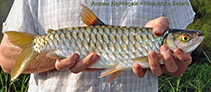
Miljö: miljö / Klimatzon / djupintervall / distributionsområde
Ekologi
; sötvatten; brackvatten pelagiska; flodvandrande (Ref. 51243). Tropical; 22°C - 28°C (Ref. 12468)
Africa: present throughout intertropical Africa (Ref. 2880, 80290, 81279). Absence from the Gambia basin is noteworthy (Ref. 81279). Present in the Nile system (Ref. 28714, 58460) up to Lake Albert (Ref. 4903) and in Lake Turkana system (Ref. 28663). Widely distributed in the Congo River basin (Ref. 5331, 42019, 42510, 45434).
Längd vid första mognad / Storlek / Vikt / Ålder
Könsmognad: Lm 18.5, range 33 - ? cm
Max length : 53.0 cm SL hane/ej könsbestämd; (Ref. 2880); publicerad maxvikt: 2.0 kg (Ref. 3799)
Taggstrålar i analfenan: 0; Mjukstrålar i analfenan: 13 - 19. Diagnosis: fronto-parietal fontanel absent in adults, sometimes pore-like in juveniles; snout long, comprimised 3x in head length; dorsal fin origin distinctly behind pelvic fin insertion; adults large-sized; no sexual dimorphism affecting anal fin shape; 21-31 lateral line scales; 4.5 scales between lateral line and dorsal fin; 10-16 anal fin branched rays; 14-22 gill rakers on lower limb of first gill arch; 8-14 teeth in outer premaxillary row (Ref. 2880, 80290, 81279). Head length/snout length 2.6-2.9; 10-12 predorsal scales (Ref. 80290). Body depth more than 3x SL in adults (Ref. 2880, 81279).
Body shape (shape guide): fusiform / normal.
More common in rivers than lakes; feeds on insects, crustaceans, fish, vegetation and debris (Ref. 28714). Considering the distribution of different forms (according to collection determinations), it should be noted that a B. macrolepidotus 'form' is found only in northern regions, while a B. schoutedi 'form' is found only in southern regions. However, between these two forms there appears to be mixing and intermediacy of forms. We consider that there are several populations which have evolved in a geographical gradient to produce different morphotypes of a single species (Ref. 80290).
Livscykel och parningsbeteende
Könsmognad | Reproduktion | Lek | Ägg | Fekunditet | Larver
Paugy, D. and S.A. Schaefer, 2007. Alestidae. p. 347-411. In M.L.J. Stiassny, G.G. Teugels and C.D. Hopkins (eds.) Poissons d'eaux douces et saumâtres de basse Guinée, ouest de l'Afrique centrale/The fresh and brackish water fishes of Lower Guinea, west-central Africa. Vol. 1. Coll. Faune et Flore tropicales 42. Istitut de recherche pour le développement, Paris, France, Muséum nationale d'histoire naturelle, Paris, France and Musée royale de l'Afrique centrale, Tervuren, Belgique. 800 p. (Ref. 80290)
Status på IUCN:s rödlista (Ref. 130435: Version 2025-2 (Global))
Hot mot människor
Harmless
Mänskliga användningsområden
Fiskeri: kommersiell
Verktyg
Särskilda rapporter
Ladda ner XML
Internet-källor
Uppskattningar baserade på modeller
Index för fylogenetisk mångfald (Ref.
82804): PD
50 = 0.5010 [Uniqueness, from 0.5 = low to 2.0 = high].
Bayesian length-weight: a=0.01000 (0.00801 - 0.01249), b=2.99 (2.93 - 3.05), in cm total length, based on LWR estimates for this species (Ref.
93245).
Trofisk nivå (Ref.
69278): 2.8 ±0.35 se; based on food items.
Generation time: 2.4 ( na - na) years. Estimated as median ln(3)/K based on 1
growth studies.
Resiliens (Ref.
120179): Hög, lägsta populationsfördubblingstid mindre än 15 månader (Preliminary K or Fecundity.).
Sårbarhet i fisket (Ref.
59153): Low to moderate vulnerability (31 of 100).
🛈