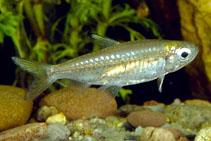
>
Characiformes (Characins) >
Alestidae (African tetras)
Etymology: Micralestes: Greek, mikros = small + Greek,lestes = thief (Ref. 45335).
Milieu: milieu / Klimaatzone / Diepte / verspreidingsgebied
Ecologie
; zoet water pelagisch; pH range: 6.0 - 7.5; dH range: ? - 16; potamodroom (Ref. 51243). Tropical; 22°C - 26°C (Ref. 12468)
Africa: found in most Sahelo-Sudanese basins of West Africa (Senegal, Volta, Niger, Chad), in the Cross River basin (Ref. 80290), in Kenya (Ref. 52871), in Sudan and South Sudan (Ref. 28714) and in Ethiopia (Ref. 58460).
Grootte / Gewicht / Leeftijd
Maturiteit: Lm ? range ? - ? cm
Max length : 6.0 cm TL mannelijk / geslacht onbekend; (Ref. 2880)
Anale stekels: 0; Anale zachte stralen: 18 - 22. Diagnosis: lateral line complete, 23-29 (Ref. 81279) or 26-29 (Ref. 80290) lateral line scales. Anal fin with 3 unbranched and 15-19 (Ref. 81279) or 16-19 (Ref. 80290) branched rays. 11-14 gill rakers on lower part of first branchial arch; 6/8 premaxillary teeth (Ref. 2880, 81279). Inner dentary teeth conical, monocuspid; scales of flank without melanophores concentrated along basal margin, pigment diffuse or absent (Ref. 80290). Fins colorless, at most, pinkish; caudal fin tinged with pink (Ref. 2880, 81279). Tip of dorsal fin usually blackish (Ref. 2880, 80290, 81279). Widely distributed, never found in Cavally River (Ref. 2880, 81279).
Body shape (shape guide): fusiform / normal.
Inhabits fringing vegetation of rivers and lakes, feeding on zooplankton, beetles and other insects (Ref. 28714). Often reported in West Africa under name of M. acutidens.
Affinities: most similar to M. acutidens, from which it differs in the presence of conical, monocuspid (vs multicuspid) inner dentary teeth, inner premaxillary and outer dentary with fewer cusps, and a slightly more slender body (Ref. 80290).
Levenscyclus en paargedrag
Maturiteit | Voortplanting | Paaien | Eieren | Fecunditeit | Larven
Paugy, D. and S.A. Schaefer, 2007. Alestidae. p. 347-411. In M.L.J. Stiassny, G.G. Teugels and C.D. Hopkins (eds.) Poissons d'eaux douces et saumâtres de basse Guinée, ouest de l'Afrique centrale/The fresh and brackish water fishes of Lower Guinea, west-central Africa. Vol. 1. Coll. Faune et Flore tropicales 42. Istitut de recherche pour le développement, Paris, France, Muséum nationale d'histoire naturelle, Paris, France and Musée royale de l'Afrique centrale, Tervuren, Belgique. 800 p. (Ref. 80290)
Status op de Rode Lijst van het IUCN (Ref. 130435: Version 2025-2 (Global))
Gevaar voor de mens
Harmless
Gebruik door de mens
Tools
Speciale rapporten
Download XML
Internetbronnen
Schattingen op basis van modellen
Fylogenetische diversiteitsindex (Ref.
82804): PD
50 = 0.5000 [Uniqueness, from 0.5 = low to 2.0 = high].
Bayesian length-weight: a=0.00891 (0.00459 - 0.01730), b=2.91 (2.74 - 3.08), in cm total length, based on LWR estimates for this species & (Sub)family-body (Ref.
93245).
Trofisch niveau (Ref.
69278): 3.3 ±0.42 se; based on food items.
Weerstandsvermogen (Ref.
120179): Hoog, minimale populatieverdubbelingstijd minder dan 15 maanden (Preliminary K or Fecundity.).
Kwetsbaarheid van de visserij (Ref.
59153): Low vulnerability (10 of 100).
🛈