>
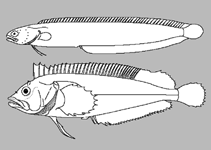
Blenniiformes (Blennies) >
Clinidae (Clinids)
Etymology: Ophiclinops: Greek, ophis = serpent + Greek, klinein, kline = sloping and bed, due to the four apophyses of sphenoid bone + Greek, ops = appearance (Ref. 45335).
More on authors: McCulloch & Waite.
Environnement : milieu / zone climatique / profondeur / gamme de distribution
Écologie
marin benthopélagique. Temperate
Indo-West Pacific: endemic to southern Australia.
Taille / Poids / Âge
Maturité: Lm ? range ? - ? cm
Max length : 5.0 cm TL mâle / non sexé; (Ref. 9002)
Found in seagrass areas among Amphibolus species with dropped leaves and other organic litter on sand (Ref. 9002). Secretive and extremely well camouflaged (Ref. 9002).
Cycle de vie et comportement reproducteur
Maturité | Reproduction | Frai | Œufs | Fécondité | Larves
Kuiter, R.H., 1993. Coastal fishes of south-eastern Australia. University of Hawaii Press. Honolulu, Hawaii. 437 p. (Ref. 9002)
Statut dans la liste rouge de l'IUCN (Ref. 130435: Version 2025-2 (Global))
Menace pour l'homme
Harmless
Utilisations par l'homme
Outils
Articles particuliers
Télécharger en XML
Sources Internet
Estimations basées sur des modèles
Indice de diversité phylogénétique (Réf.
82804): PD
50 = 0.6250 [Uniqueness, from 0.5 = low to 2.0 = high].
Bayesian length-weight: a=0.00501 (0.00221 - 0.01134), b=3.06 (2.86 - 3.26), in cm total length, based on LWR estimates for this (Sub)family-body shape (Ref.
93245).
Niveau trophique (Réf.
69278): 3.2 ±0.4 se; based on size and trophs of closest relatives
Résilience (Réf.
120179): Haut, temps minimum de doublement de population inférieur à 15 mois (Preliminary K or Fecundity.).
Vulnérabilité de la pêche (Ref.
59153): Low vulnerability (10 of 100).
🛈