分类 / 名称
俗名 | 同种异名 | Catalog of Fishes(属, 种) | ITIS | CoL | WoRMS | Cloffa
Teleostei >
Characiformes (Characins) >
Distichodontidae (Distichodus)
Etymology: Nannaethiops: Latin, nannus = small + Aethiops, with appearance of being from Aethiopia, the nord east African region (Ref. 45335).
More on author: Günther.
Taxonomic Remarks
Type species of genus (monotypic) (Ref. 81638).
环境:氛围 / 气候带 / 深度上下限 / 分布范围
生态学
; 淡水 大洋性; pH range: 6.5 - 7.5; dH range: ? - 12. 熱帶; 23°C - 26°C (Ref. 1672)
Africa: Niger and Cross River in Nigeria (Ref. 2936, 31256, 86396) and Chad basin (Ref. 367, 86396). Found in Cameroon, Gabon, Equatorial Guinea, DRCongo, Republic of Congo, Cabinda (Ref. 81638). Also reported from Ghana (Ref. 11235) and the lower part of the Congo basin (Ref. 2936, 94734). Reports from other parts of the Congo basin (Ref. 1878, 1879, 41591, 46861) need confirmation.
非洲: 在奈及利亞,喀麥隆,加彭,剛果的尼日與十字河, 剛果河流域的較下面的部位。 記錄來自迦納 (參考文獻 11235) 與查德流域了。 (參考文獻 367)
大小 / 重量 / 年龄
成熟度: Lm ? range ? - ? cm
Max length : 6.2 cm TL 雄鱼/尚未辨别雌雄; (Ref. 2936)
背棘 (总数) : 0; 背的软条 (总数) : 12 - 14; 臀棘: 0; 臀鳍软条: 9 - 11. Diagnosis: distinguished from Neolebias by its always complete lateral line; caudal peduncle 1-1.5x longer that high (Ref. 2936, 86396). 32-36 scales in a longitudinal series (Ref. 81638, 86396). Four, rarely 5, scales between dorsal fin origin and lateral line (Ref. 81638). 11-16 (Ref. 86396) or 12-14 (Ref. 81638) total dorsal fin rays. 10 (Ref. 86396) or 9-11 (Ref. 81638) total anal fin rays.
Body shape (shape guide): fusiform / normal; Cross section: compressed.
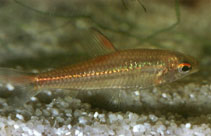
尾柄 1-1.5 x 比较长的那高者。 延伸至眼的前缘的上颌骨。 侧线总是完成。 身体的上半部灰色的橄榄色, 较下面的部位白黄色的。 在顶端的从眼到尾部又深色的斑纹在尾部与黑色斑点的中央的深色的侧面条纹背部的。
Distinguished from Neolebias by its always complete lateral line (Ref. 2936). Feeds on worms, crustaceans and insects (Ref. 7020).
与 Neolebias 区分了用它的总是侧线完整。 吃蠕虫,甲壳动物与昆虫。 (参考文献 7020)
生命周期和交配行为
成熟度 | 繁殖 | 产卵场 | 卵 | 孕卵数 | 仔鱼
非洲: 在奈及利亞,喀麥隆,加彭,剛果的尼日與十字河, 剛果河流域的較下面的部位。 記錄來自迦納 (參考文獻 11235) 與查德流域了。 (參考文獻 367)
Gosse, J.-P. and E.J. Coenen, 1990. Distichodontidae. p. 237-260. In C. Lévêque, D. Paugy and G.G. Teugels (eds.) Faune des poissons d'eaux douces et saumâtres de l'Afrique de l'Ouest. Tome I. Coll. Faune Tropicale n° XXVIII. Musée Royal de l'Afrique Centrale, Tervuren and O.R.S.T.O.M., Paris, 384 p. (Ref. 2936)
世界自然保护联盟红皮书 (Ref. 130435: Version 2025-2 (Global))
人类利用
水族馆: 商业性
工具
特别资料
下载 XML
网络资源
基于模型的估算
系统发育多样性指数 (参考文献
82804): PD
50 = 0.7500 [Uniqueness, from 0.5 = low to 2.0 = high].
Bayesian length-weight: a=0.01230 (0.00608 - 0.02487), b=2.87 (2.70 - 3.04), in cm total length, based on LWR estimates for this species & (Sub)family-body (Ref.
93245).
营养阶层 (参考文献
69278): 3.0 ±0.37 se; based on food items.
渔业脆弱性 (Ref.
59153): Low vulnerability (10 of 100).
🛈