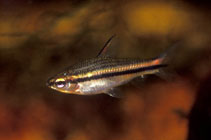
Environnement : milieu / zone climatique / profondeur / gamme de distribution
Écologie
; eau douce pélagique; pH range: 6.0 - 7.0; dH range: ? - 8. Tropical; 24°C - 28°C (Ref. 12468)
Africa: occurs from Gambia to Chad basin except the Senegal River basin (Ref. 2936, 86396). Present in Republic of Congo (Ref. 81638), Cameroon and Gabon (Ref. 2936, 81638) and as far south as the Chiloango in Democratic Republic of the Congo (Ref. 94734). In the middle Congo basin, known from the Sangha drainage in Cameroon (Ref. 51193), Sangha and Alima and Republic of Congo (Ref. 42035) and Ubangi in Central African Republic (Ref. 2936, 94734).
Taille / Poids / Âge
Maturité: Lm ? range ? - ? cm
Max length : 4.2 cm SL mâle / non sexé; (Ref. 7094)
Épines dorsales (Total) : 0; Rayons mous dorsaux (Total) : 12 - 15; Épines anales: 0; Rayons mous anaux: 10 - 11. Diagnosis: body depth 2.8-3.8x and head length 1.8-2.2x in SL (Ref. 2936, 86396). 33-35 lateral line scales (Ref. 2936, 81638, 86396). Laterosensory canal on lateral surface of head limited to arch of pores around ventral and posterior margins of orbit and associated with preopercle; 6th infraorbital (dermosphenotic) present, with laterosensory canal segment; infraorbital present at posterior margin of orbit; maxilla with 4 or fewer teeth; maxilla falling short of vertical through anterior margin of orbit; scaly process present at base of pelvic fin; dark pigmentation along lateral surface of body two scales wide or less; dark band on lateral surface of body passing through middle of caudal peduncle; base of caudal fin unpigmented or with rounded spot that falls distinctly short of dorsal and ventral margins of caudal peduncle (Ref. 81638). 12-15 total dorsal fin rays and 10-11 total anal fin rays (Ref. 2936, 81638, 86396).
Body shape (shape guide): fusiform / normal.
Maximum TL was recorded at 5.3 cm (Ref. 7094).
Cycle de vie et comportement reproducteur
Maturité | Reproduction | Frai | Œufs | Fécondité | Larves
Daget, J. and J.-P. Gosse, 1984. Distichodontidae. p. 184-211. In J. Daget, J.-P. Gosse and D.F.E. Thys van den Audenaerde (eds.) Check-list of the freshwater fishes of Africa (CLOFFA). ORSTOM, Paris and MRAC, Tervuren. Vol. 1. (Ref. 7094)
Statut dans la liste rouge de l'IUCN (Ref. 130435: Version 2025-2 (Global))
Menace pour l'homme
Harmless
Utilisations par l'homme
Outils
Articles particuliers
Télécharger en XML
Sources Internet
Estimations basées sur des modèles
Indice de diversité phylogénétique (Réf.
82804): PD
50 = 0.5002 [Uniqueness, from 0.5 = low to 2.0 = high].
Bayesian length-weight: a=0.01288 (0.00726 - 0.02285), b=3.12 (2.96 - 3.28), in cm total length, based on LWR estimates for this species & (Sub)family-body (Ref.
93245).
Niveau trophique (Réf.
69278): 3.5 ±0.4 se; based on size and trophs of closest relatives
Vulnérabilité de la pêche (Ref.
59153): Low vulnerability (10 of 100).
🛈