Environnement : milieu / zone climatique / profondeur / gamme de distribution
Écologie
; eau douce démersal. Tropical
Africa: known from Senegal, Casamance, Niger, Volta, Chad basin and certain coastal rivers in Guinéa-Bissau, Togo and Benin (Ref. 2938, 7095, 81281). Also in the Nile and Lake Mobutu Sese Seko (Lake Albert) (Ref. 2938, 7095, 28714).
Taille / Poids / Âge
Maturité: Lm ? range ? - ? cm
Max length : 84.0 cm SL mâle / non sexé; (Ref. 7095); poids max. publié: 2.5 kg (Ref. 3799)
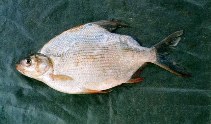
Rayons mous dorsaux (Total) : 20 - 23; Rayons mous anaux: 23 - 26. Diagnosis: 59-77 lateral line scales (Ref. 28714, 81281). Body depth 1.6-1.9 times and head length 3.3-4.3 times in SL; caudal peduncle length 0.6-0.8 times its depth; short snout, 0.9-1.5 times eye diameter; eye diameter 3.9-6 times in head length; adipose-fin base 1.4-2 times longer than distance separating it from rayed dorsal fin; pointed pectoral fins, shorter than head (0.6-0.85 times head length) and as long as pelvic fins; cycloid scales; scale formula 17.5-18.5/59-71/18.5-19.5; 13.5-15.5 scales between lateral line and pelvic-fin base; 20-23 dorsal fin rays; 23-26 anal fin rays (Ref. 2938, 81281).
Body shape (shape guide): short and / or deep; Cross section: compressed.
Occurs in open water and vegetation beds of lakes and flowing water; ingests mud containing benthic and sedimented algae; spawns in the perennial wetland at high water (in the Sudd in South Sudan) (Ref. 28714).
Cycle de vie et comportement reproducteur
Maturité | Reproduction | Frai | Œufs | Fécondité | Larves
Gosse, J.-P., 1990. Citharinidae. p. 261-268. In C. Lévêque, D. Paugy and G.G. Teugels (eds.) Faune des poissons d'eaux douces et saumâtres de l'Afrique de l'Ouest. Tome I. Coll. Faune Tropicale n° XXVIII. Musée Royal de l'Afrique Centrale, Tervuren and O.R.S.T.O.M., Paris, 384 p. (Ref. 2938)
Statut dans la liste rouge de l'IUCN (Ref. 130435: Version 2025-2 (Global))
Menace pour l'homme
Harmless
Utilisations par l'homme
Pêcheries: commercial
Outils
Articles particuliers
Télécharger en XML
Sources Internet
Estimations basées sur des modèles
Indice de diversité phylogénétique (Réf.
82804): PD
50 = 0.5195 [Uniqueness, from 0.5 = low to 2.0 = high].
Bayesian length-weight: a=0.01413 (0.00662 - 0.03015), b=2.98 (2.79 - 3.17), in cm total length, based on LWR estimates for this species & (Sub)family-body (Ref.
93245).
Niveau trophique (Réf.
69278): 2.2 ±0.13 se; based on food items.
Résilience (Réf.
120179): Milieu, temps minimum de doublement de population : 1,4 à 4,4 années (Preliminary K or Fecundity.).
Vulnérabilité de la pêche (Ref.
59153): High vulnerability (61 of 100).
🛈
Nutriments (Ref.
124155): Calcium = 67.1 [28.4, 160.5] mg/100g; Iron = 1.39 [0.69, 3.27] mg/100g; Protein = 18.1 [16.0, 20.3] %; Omega3 = 0.299 [0.112, 0.820] g/100g; Selenium = 104 [42, 243] μg/100g; VitaminA = 12 [3, 39] μg/100g; Zinc = 1.39 [0.93, 2.15] mg/100g (wet weight);