Olocefali (chimere) (chimaeras) >
Chimaeriformes (Chimaeras) >
Rhinochimaeridae (Longnose chimaeras)
Etymology: Rhinochimaera: A chimaera with rhinos (Gr.), nose, referring to long, pointed proboscis of R. pacifica (See ETYFish); africana: ana- (L.), belonging to: named for both its distribution around southern Africa and for the Sea Fisheries Research Institute research vessel Africana, from which holotype was collected (See ETYFish).
Ambiente: milieu / zona climatica / distribuzione batimetrica / gamma di distribuzione
Ecologia
marino batidemersale; distribuzione batimetrica 549 - 1450 m (Ref. 11228). Deep-water
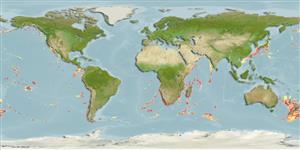
Southeast Atlantic: southern Africa and Mozambique Channel. Pacific Ocean: Japan (off Hokkaido and northern Honshu) to the east China Sea, including Taiwan; Costa Rica and Peru.
Dimensione / Peso / Età
Maturità: Lm ? range ? - ? cm
Max length : 81.8 cm TL maschio/sesso non determinato; (Ref. 97389)
Breve descrizione
Chiavi di identificazione | Morfologia | Morfometria
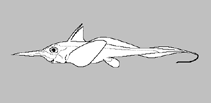
This species is distinguished by the following characters: elongate body with an elongate, broad and paddle-shaped pointed snout extending anterior to head (SNL 47.7% HDL), tapering to a slender tail; the junction of supraorbital and infraorbital canals on ventral side of snout is closer to the tip of the snout than to the nasal canal; ONC/TIO is greater than 1.4 (ONC/TIO= 1.64); TIO/SWF is less than 1.5 (TIO/SWF= 1.47); TIO/LNC is less than 3.0 (TIO/LNC= 2.75); tooth-plates are nearly smooth; eyes are relatively small (EYL 6.4% BDL), distinctly behind level of mouth; the first and second dorsal fins are separated by a relatively long interdorsal space (IDS 23.6% BDL) and not connected by a web of skin; caudal-fin axis weakly raised with the fin asymmetrical, the epaxial caudal-fin lobe narrower than hypaxial lobe; dorsal caudal tubercles 25; caudal filament vestigial; coloration uniformly dark brown across entire body, except the oronasal region which is abruptly paler than the body (Ref. 97389).
Body shape (shape guide): elongated; Cross section: angular.
Rare (Ref. 11228). Oviparous (Ref. 205). Eggs are encased in horny shells (Ref. 205).
Ciclo vitale e comportamento di accoppiamento
Maturità | Riproduzione | Deposizione | Uova | Fecondità | Larve
Heemstra, P.C., 1995. Additions and corrections for the 1995 impression. p. v-xv. In M.M. Smith and P.C. Heemstra (eds.) Revised Edition of Smiths' Sea Fishes. Springer-Verlag, Berlin. (Ref. 11228)
Stato della Lista Rossa IUCN (Ref. 130435: Version 2025-2 (Global))
Minaccia per l'uomo
Harmless
Usi umani
Strumenti
Rapporti speciali
Scarica XML
Fonti Internet
Stime basate su modelli
Temperatura preferita (Fonte Biblio.
123201): 2.1 - 8.2, mean 5.5 °C (based on 195 cells).
Indice di diversità filogenetica (Fonte Biblio.
82804): PD
50 = 0.6270 [Uniqueness, from 0.5 = low to 2.0 = high].
Bayesian length-weight: a=0.00195 (0.00083 - 0.00455), b=3.14 (2.94 - 3.34), in cm total length, based on LWR estimates for this (Sub)family-body shape (Ref.
93245).
Livello trofico (Fonte Biblio.
69278): 3.8 ±0.5 se; based on size and trophs of closest relatives
Resilienza (Fonte Biblio.
120179): Basso, tempo minimo di raddoppiamento della popolazione 4.5 - 14 anni (Assuming Fec <100).
Vulnerabilità della pesca (Ref.
59153): Moderate to high vulnerability (53 of 100).
🛈