>
Cypriniformes (Carps) >
Cyprinidae (Minnows or carps) > Labeoninae
Etymology: Garra: Name based on a vernacular Indian name (Hamilton, 1822:343, Ref. 1813); a fish living in mud (Ref. 128817).
More on author: Roberts.
Environnement : milieu / zone climatique / profondeur / gamme de distribution
Écologie
; eau douce benthopélagique. Tropical
Africa: Only known from Bamenda highlands of the Niger basin (Ref. 2940, 81282, 96454).
Taille / Poids / Âge
Maturité: Lm ? range ? - ? cm
Max length : 6.3 cm SL mâle / non sexé; (Ref. 81282)
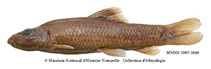
Épines dorsales (Total) : 0; Rayons mous dorsaux (Total) : 10; Épines anales: 0; Rayons mous anaux: 8. Diagnosis: Garra allostoma is an insectivorous Garra with a terminal or subterminal mouth and curved or crescentic mouth opening superficially resembling a generalized Barbus; cheek below eye laterally expanded; rostral cap reduced, smooth; mental disc smooth, non tuberculate, posterior border bound to isthmus; upper and lower lips well developed; lower lip non-tuberculate, divided into distinct, lateral and medial portions by a constriction; medial portion of lower lip constricted near symphysis, so that it is bilobate; horny sheaths of upper and lower jaws not greatly enlarged, without trenchant cutting edge; pharyngeal teeth in two rows, 2 or 3,5 (Ref. 96454). Absence of rostral fimbriae distinguished Garra allostoma from all other Garra, and having only two instead of three pharyngeal tooth rows distinguished it from all others for which the number of rows has been reported (Ref. 96454).
Body shape (shape guide): elongated.
At first sight this species resembles Barbus because of his non-denticulated rostral lobe and his small non-tuberculated disc (Ref. 2940).
Cycle de vie et comportement reproducteur
Maturité | Reproduction | Frai | Œufs | Fécondité | Larves
Lévêque, C., 2003. Cyprinidae. p. 322-436. In D. Paugy, C. Lévêque and G.G Teugels (eds.) The fresh and brackish water fishes of West Africa Volume 1. Coll. faune et flore tropicales 40. Institut de recherche de développement, Paris, France, Muséum national d'histoire naturelle, Paris, France and Musée royal de l'Afrique Central, Tervuren, Belgium, 457p. (Ref. 81282)
Statut dans la liste rouge de l'IUCN (Ref. 130435: Version 2025-2 (Global))
Menace pour l'homme
Harmless
Utilisations par l'homme
Pêcheries: sans intérêt
Outils
Articles particuliers
Télécharger en XML
Sources Internet
Estimations basées sur des modèles
Indice de diversité phylogénétique (Réf.
82804): PD
50 = 0.5000 [Uniqueness, from 0.5 = low to 2.0 = high].
Bayesian length-weight: a=0.00794 (0.00359 - 0.01758), b=3.04 (2.87 - 3.21), in cm total length, based on LWR estimates for this Genus-body shape (Ref.
93245).
Résilience (Réf.
120179): Haut, temps minimum de doublement de population inférieur à 15 mois (Preliminary K or Fecundity.).
Vulnérabilité de la pêche (Ref.
59153): Low vulnerability (10 of 100).
🛈