>
Eupercaria/misc (Various families in series Eupercaria) >
Labridae (Wrasses) > Julidinae
Etymology: Coris: Greek, kore, -es = pupil and also with themenaing of "maid" (Ref. 45335).
Eponymy: Georges Léopold Chrétien Frédéric Dagobert Baron Cuvier (1769–1832), better known by his pen name Georges Cuvier, was a French naturalist and one of the scientific giants of his age. [...] (Ref. 128868), visit book page.
More on author: Bennett.
Umwelt: Milieu / Klimazone / Tiefenbereich / Verbreitungsgebiet
Ökologie
seewasser riff-verbunden; tiefenbereich 2 - 50 m (Ref. 90102). Tropical; - 30°S
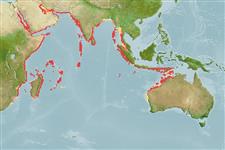
Indian Ocean: Red Sea and along the southern Arabian Peninsula south to Zanzibar and South Africa (30°S) and east to the Laccadive Archipelago, Chagos Archipelago, Maldives, Sri Lanka, and the Similan Islands, eastern Andaman Sea.
Größe / Gewicht / Alter
Geschlechtsreife: Lm ? range ? - ? cm
Max length : 38.0 cm TL Männchen/unbestimmt; (Ref. 11441)
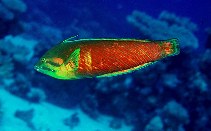
Inhabits exposed outer reef flats and lagoon and seaward reefs, in areas of mixed sand, coral and rubble (Ref. 9710). Juveniles occur in small tide pools, exposed reef flats with algae-rubble. Generally solitary (Ref. 5213). Feeds mainly on hard-shelled prey, including crustaceans, mollusks and sea urchins (Ref. 5374). Turns over rocks to prey on hiding invertebrates (Ref. 11441). Young look very different (Ref. 1623).
Lebenszyklus und Paarungsverhalten
Geschlechtsreife | Fortpflanzung | Ablaichen | Eier | Fruchtbarkeit | Larven
Oviparous, with distinct pairing during breeding (Ref. 205).
Randall, J.E., 1999. Revision of the Indo-Pacific labrid fishes of the genus Coris, with descriptions of five new species. Indo-Pac. Fish. (29):74 p. (Ref. 33411)
IUCN Rote Liste Status (Ref. 130435: Version 2025-2 (Global))
Bedrohung für Menschen
Harmless
Nutzung durch Menschen
Fischereien: weniger kommerziell
Tools
Zusatzinformationen
Download XML
Internet Quellen
Schätzungen auf der Grundlage von Modellen
Bevorzugte Temperatur (Ref.
123201): 25.3 - 29.3, mean 27.9 °C (based on 466 cells).
Phylogenetischer Diversitätsindex (Ref.
82804): PD
50 = 0.5000 [Uniqueness, from 0.5 = low to 2.0 = high].
Bayesian length-weight: a=0.00977 (0.00468 - 0.02039), b=3.07 (2.90 - 3.24), in cm total length, based on LWR estimates for this (Sub)family-body shape (Ref.
93245).
Trophische Ebene (Ref.
69278): 3.4 ±0.40 se; based on food items.
Widerstandsfähigkeit (Ref.
120179): mittel, Verdopplung der Population dauert 1,4 - 4,4 Jahre. (Preliminary K or Fecundity.).
Anfälligkeit der Fischerei (Ref.
59153): Low to moderate vulnerability (28 of 100).
🛈
Nährstoffe (Ref.
124155): Calcium = 37.3 [14.6, 100.0] mg/100g; Iron = 0.563 [0.336, 0.995] mg/100g; Protein = 18.5 [15.7, 20.7] %; Omega3 = 0.128 [0.064, 0.250] g/100g; Selenium = 34 [13, 94] μg/100g; VitaminA = 99.7 [32.6, 340.8] μg/100g; Zinc = 1.91 [0.89, 3.42] mg/100g (wet weight);