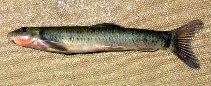
>
Cypriniformes (Carps) >
Cyprinidae (Minnows or carps) > Labeoninae
Etymology: Garra: Name based on a vernacular Indian name (Hamilton, 1822:343, Ref. 1813); a fish living in mud (Ref. 128817).
More on author: Rüppell.
Taxonomic Remarks
There has been confusion between G. dembeensis, G. johnstonii and G. hindii. G. johnstonii is a junior synonym of G. dembeensis, but G. hindii differs in having a fully scaled predorsum, belly and chest; it does, however, share two important meristic and morphometric features with G. dembeensis: high number of scales in lateral line and vent located away from anal fin (Ref. 81639).
Umwelt: Milieu / Klimazone / Tiefenbereich / Verbreitungsgebiet
Ökologie
; süßwasser benthopelagisch. Tropical; 22°C - 26°C (Ref. 2059)
Africa: widespread with presence in East Africa, including Ethiopia, Egypt, Kenya and Tanzania, as well as in Cameroon, Nigeria and Tchad (Ref. 2801, 2940, 58532, 81282, 81639). Presence in the Congo basin (Ref. 11970, 41590, 41594, 106290, 120641) not confirmed in Ref. 58532.
Größe / Gewicht / Alter
Geschlechtsreife: Lm ? range ? - ? cm
Max length : 11.0 cm SL Männchen/unbestimmt; (Ref. 4967)
Rückenflossenstacheln (insgesamt) : 0; Rückenflossenweichstrahlen (insgesamt) : 10 - 11; Afterflossenstacheln: 0; Afterflossenweichstrahlen: 9. Diagnosis: Garra dembeensis is distinguished from African congeners by the following combination of features: well-developed disc; between 0 and 4 predorsal scales anterior to dorsal fin; asquamate chest, belly and postpelvic region; intestine of medium length; ad moderately sized gas bladder (Ref. 58532).
Body shape (shape guide): elongated.
Commonly found in rapid parts of rivers and also on wave-washed rocky shores of Lake Victoria (Ref. 4903). Adheres to stones in swift water (Ref. 28714). Feeds on epilithic algae and lithophilic insects (Ref. 12526), scraped from the surface of rocks (Ref. 4903).
Lebenszyklus und Paarungsverhalten
Geschlechtsreife | Fortpflanzung | Ablaichen | Eier | Fruchtbarkeit | Larven
Lévêque, C., 1990. Cyprinidae. p. 269-361. In C. Lévêque, D. Paugy and G.G. Teugels (eds.) Faune des poissons d'eaux douces et saumâtres d'Afrique de l'Ouest. Tome I. Coll. Faune Tropicale n° XXVIII. Musée Royal de l'Afrique Centrale, Tervuren, and O.R.S.T.O.M., Paris, 384 p. (Ref. 2940)
IUCN Rote Liste Status (Ref. 130435: Version 2025-2 (Global))
Bedrohung für Menschen
Harmless
Nutzung durch Menschen
Fischereien: nicht kommerziell
Tools
Zusatzinformationen
Download XML
Internet Quellen
Schätzungen auf der Grundlage von Modellen
Phylogenetischer Diversitätsindex (Ref.
82804): PD
50 = 0.5000 [Uniqueness, from 0.5 = low to 2.0 = high].
Bayesian length-weight: a=0.00794 (0.00359 - 0.01758), b=3.04 (2.87 - 3.21), in cm total length, based on LWR estimates for this Genus-body shape (Ref.
93245).
Trophische Ebene (Ref.
69278): 2.0 ±0.00 se; based on food items.
Widerstandsfähigkeit (Ref.
120179): hoch, Verdopplung der Population dauert weniger als 15 Monate. (Preliminary K or Fecundity.).
Anfälligkeit der Fischerei (Ref.
59153): Low vulnerability (10 of 100).
🛈