Classificazione / Nomi
Nomi Comuni | Sinonimi | Catalog of Fishes(Genere, Specie) | ITIS | CoL | WoRMS | Cloffa
>
Characiformes (Characins) >
Anostomidae (Headstanders)
Etymology: Megaleporinus: Name from Greek 'mega' meaning large or largest, plus Leporinus, the genus which most species (now in this genus) were previously assigned; refrring to the large size of most congeners.
More on author: Valenciennes.
Ambiente: milieu / zona climatica / distribuzione batimetrica / gamma di distribuzione
Ecologia
; acqua dolce benthopelagico; potamodromo (Ref. 51243). Subtropical
South America: Known only from the Rio Jequitinhonha and Rio Pardo in Brazil. Record from São Francisco River, the type locality in the original description, seems to be erroneous (Ref. 93038). Reported from Paraná and La Plata basins (Ref. 36801).
Lunghezza alla prima maturità / Dimensione / Peso / Età
Maturità: Lm 20.8 range ? - ? cm
Max length : 50.0 cm TL maschio/sesso non determinato; (Ref. 115169)
Breve descrizione
Chiavi di identificazione | Morfologia | Morfometria
Raggi dorsali molli (totale) : 11 - 12; Raggi anali molli: 10 - 11; Vertebre: 34. Distinguished from all species of Leporinus , exceptL. amblyrhynchus , by having
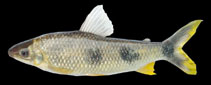
the combination of three teeth on each premaxilla and dentary (tooth formula 3/3) and 12 scale rows around the caudal peduncle (vs. tooth formulae 4/4, 3/4 or 4/3, and 14 or 16 scale rows around the caudal peduncle). Can be diagnosed from Leporinus amblyrhynchus by having three dark blotches on the lateral line (vs. dark longitudinal stripe along the lateral line). Additional characters useful to diagnose Leporinus elongatus include 36 or 37 pored scales on the lateral line, 4 scales rows from the dorsal fin origin to the lateral line and 4 from the lateral line to the base of the pelvic fin (Ref. 93038).
Body shape (shape guide): elongated; Cross section: compressed.
Distinct pairs breed on densely grown weedy places (Ref. 205).
Ciclo vitale e comportamento di accoppiamento
Maturità | Riproduzione | Deposizione | Uova | Fecondità | Larve
Distinct pairs breed on densely grown weedy places (Ref. 205).
Ramirez, J.L., J.L.O. Birindelli and P.M. Galetti Jr., 2017. A new genus of Anostomidae (Ostariophysi: Characiformes): Diversity, phylogeny and biogeography based on cytogenetic, molecular and morphological data. Molecular Phylogenetics and Evolution, 107: 308-323. (Ref. 113781)
Stato della Lista Rossa IUCN (Ref. 130435: Version 2025-2 (Global))
Minaccia per l'uomo
Harmless
Usi umani
Strumenti
Rapporti speciali
Scarica XML
Fonti Internet
Stime basate su modelli
Indice di diversità filogenetica (Fonte Biblio.
82804): PD
50 = 0.5010 [Uniqueness, from 0.5 = low to 2.0 = high].
Bayesian length-weight: a=0.01096 (0.00863 - 0.01393), b=3.07 (3.03 - 3.11), in cm total length, based on LWR estimates for this species (Ref.
93245).
Livello trofico (Fonte Biblio.
69278): 2.5 ±0.1 se; based on size and trophs of closest relatives
Resilienza (Fonte Biblio.
120179): Medio, tempo minimo di raddoppiamento della popolazione 1.4 - 4.4 anni (Preliminary K or Fecundity.).
Vulnerabilità della pesca (Ref.
59153): Moderate vulnerability (40 of 100).
🛈