>
Holocentriformes (Squirrelfishes, soldierfishes) >
Holocentridae (Squirrelfishes, soldierfishes) > Holocentrinae
Etymology: Sargocentron: Greek, sargos = sargus + Greek, kentron = sting (Ref. 45335); marisrubri: From the Latin translation of 'Red Sea'.
More on authors: Randall, Golani & Diamant.
Environnement : milieu / zone climatique / profondeur / gamme de distribution
Écologie
marin démersal; profondeur 39 - 350 m (Ref. 58488). Tropical
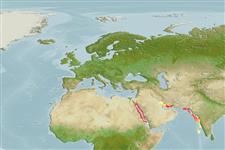
Western Indian Ocean: known only from two localities, Egypt (Gulf of Elat = Gulf of Aqaba), and Sudan.
Taille / Poids / Âge
Maturité: Lm ? range ? - ? cm
Max length : 18.3 cm SL mâle / non sexé; (Ref. 3079)
Description synthétique
Clés d'identification | Morphologie | Morphométrie
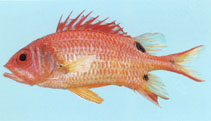
Épines dorsales (Total) : 11; Rayons mous dorsaux (Total) : 13; Épines anales: 4; Rayons mous anaux: 8 - 9. Sudan fish with light red body, silvery iridescence dorsally, pinkish silvery white ventrally, with faint alternating silvery white and light red stripes following the scale rows; Gulf of Aqaba fish golden yellow body, dorsal scales edged with orange-red; with broad pale yellow stripes following centers of scale rows; 5 oblique scale rows on cheek; body depth 2.7-2.95 in SL; head length (HL) 2.5-2.75 in SL; snout length 3.4-3.95 in HL; interorbital width 7.75-5.7 in HL; slender caudal peduncle, depth 3.9-4.65 in HL; mouth terminal; maxilla extending from below center of the eye to nearly vertical at rear edge of the pupil; upper jaw length 2.15-2.3 in HL; surface or medial edge of nasal bone spineless; moderately large nasal fossa spineless or with 1or 2 spinules on margin; side of first suborbital bone beneath the anterior part of orbit without lateral or retrorse spine, however, the low ridge has occasional, indistinct, recumbent serrae continuing along the upper edge of suborbital series; preopercular spine 3.55-5.0 in HL; longest dorsal spines 2.0-2.3 in HL; 3rd anal spine 1.35-1.44 in HL (Ref. 27370).
Body shape (shape guide): fusiform / normal; Cross section: oval.
Found in reefs in small aggregations.
Cycle de vie et comportement reproducteur
Maturité | Reproduction | Frai | Œufs | Fécondité | Larves
Randall, J.E., 1998. Revision of the Indo-Pacific squirrelfishes (Beryciformes: Holocentridae: Holocentrinae) of the genus Sargocentron, with descriptions of four new species. Indo-Pac. Fish. (27):105 p. (Ref. 27370)
Statut dans la liste rouge de l'IUCN (Ref. 130435: Version 2025-2 (Global))
Menace pour l'homme
Harmless
Utilisations par l'homme
Pêcheries: sans intérêt
Outils
Articles particuliers
Télécharger en XML
Sources Internet
Estimations basées sur des modèles
Température préférée (Réf.
123201): 21.3 - 25.8, mean 23.2 °C (based on 21 cells).
Indice de diversité phylogénétique (Réf.
82804): PD
50 = 0.5000 [Uniqueness, from 0.5 = low to 2.0 = high].
Bayesian length-weight: a=0.01698 (0.00810 - 0.03560), b=2.96 (2.79 - 3.13), in cm total length, based on LWR estimates for this Genus-body shape (Ref.
93245).
Niveau trophique (Réf.
69278): 3.5 ±0.3 se; based on size and trophs of closest relatives
Résilience (Réf.
120179): Haut, temps minimum de doublement de population inférieur à 15 mois (Preliminary K or Fecundity.).
Vulnérabilité de la pêche (Ref.
59153): Low vulnerability (12 of 100).
🛈