Umwelt: Milieu / Klimazone / Tiefenbereich / Verbreitungsgebiet
Ökologie
seewasser; brackwasser riff-verbunden; tiefenbereich 4 - 160 m (Ref. 5222), usually 20 - 45 m (Ref. 5222). Tropical; 36°N - 35°S, 22°E - 124°W
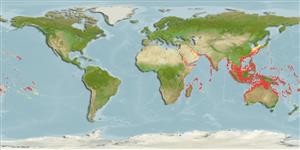
Indo-Pacific: Red Sea to South Africa and eastward to the Pitcairn Group, north to Japan and Korea, south to the Arafura Sea (Ref. 9819), southern Queensland (Australia) and Lord Howe Island.
Länge bei der ersten Reifung / Größe / Gewicht / Alter
Geschlechtsreife: Lm ?, range 16 - ? cm
Max length : 52.0 cm TL Männchen/unbestimmt; (Ref. 1238); common length : 22.0 cm TL Männchen/unbestimmt; (Ref. 5450); max. veröff. Gewicht: 2.0 kg (Ref. 30874)
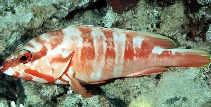
Rückenflossenstacheln (insgesamt) : 11; Rückenflossenweichstrahlen (insgesamt) : 15 - 17; Afterflossenstacheln: 3; Afterflossenweichstrahlen: 8. This species is distinguished by the following characters: body depth 2.8-3.3 in SL (for specimens 10-26 cm SL); head length 2.3-2.6 in SL; flat interorbital area, convex dorsal head profile; snout length 4.3-5.1 in HL; preopercle rounded, rear edge serrate, with lower most serrae slightly enlarged; upper edge of operculum straight; midlateral part of lower jaw with 2-4 rows of teeth; gill rakers of first gill arch 6-8 + 15-17; pyloric caeca 10-16; caudal fin slightly to moderately rounded (Central-Pacific often with truncate caudal fins); ctenoid scales on body except cycloid anterodorsally above lateral line and on thorax and ventrally on abdomen, with numerous auxiliary scales; nape and dorsoposterior part of head densely covered with minute auxiliary scales; lateral-line scales 49-75. Colour variable, ranging from pale greenish grey to pale reddish yellow to scarlet; body often with 5 or 6 faint dark bars, the last on peduncle; body scales (except ventrally) with pale centre and dark rear margin, producing a faint checked pattern; the outer triangular part of interspinous membranes of dorsal fin black (dark red in fish from Western Australia and in some specimens from deep water), with pale yellow or white spot behind tip of each spine (Ref. 39231, 89707, 90102).
Body shape (shape guide): fusiform / normal; Cross section: compressed.
Common in outer reef slopes at depths below 15 m, also occurs in protected bays and lagoons as shallow as 4 m. May also be found down to a depth of 160 m. At Madagascar it feeds night and day on brachyuran crabs, fishes, shrimps, and galatheid crabs (Ref. 6774). In Kenyan waters it feeds on crabs, stomatopods, fishes, ophiuroids, and octopus (Ref. 6448). In the Red Sea, mostly fishes and some crustaceans (mainly crabs) are consumed (Ref. 6699). Readily caught with hook-and-line, spear, traps, and gill nets (Ref. 39231)..
Lebenszyklus und Paarungsverhalten
Geschlechtsreife | Fortpflanzung | Ablaichen | Eier | Fruchtbarkeit | Larven
This species exhibits a combination of simultaneous and sequential hermaphroditism. Smaller individuals within a social group are simultaneous hermaphrodites, while the largest often lose female function and reproduce exclusively as a male (Ref. 103751).
Heemstra, P.C. and J.E. Randall, 1993. FAO Species Catalogue. Vol. 16. Groupers of the world (family Serranidae, subfamily Epinephelinae). An annotated and illustrated catalogue of the grouper, rockcod, hind, coral grouper and lyretail species known to date. Rome: FAO. FAO Fish. Synop. 125(16):382 p. (Ref. 5222)
IUCN Rote Liste Status (Ref. 130435: Version 2025-2 (Global))
Bedrohung für Menschen
Reports of ciguatera poisoning (Ref. 30298)
Nutzung durch Menschen
Fischereien: kommerziell; Sportfisch: ja; Aquarium: Kommerziell
Tools
Zusatzinformationen
Download XML
Internet Quellen
Schätzungen auf der Grundlage von Modellen
Bevorzugte Temperatur (Ref.
123201): 24.5 - 29, mean 28 °C (based on 1100 cells).
Phylogenetischer Diversitätsindex (Ref.
82804): PD
50 = 0.5000 [Uniqueness, from 0.5 = low to 2.0 = high].
Bayesian length-weight: a=0.01148 (0.01031 - 0.01279), b=3.04 (3.02 - 3.06), in cm total length, based on LWR estimates for this species (Ref.
93245).
Trophische Ebene (Ref.
69278): 3.7 ±0.4 se; based on diet studies.
Generation time: 7.1 ( na - na) years. Estimated as median ln(3)/K based on 1
growth studies.
Widerstandsfähigkeit (Ref.
120179): niedrig, Verdopplung der Population dauert 4,5 - 14 Jahre. (K=0.16).
Anfälligkeit der Fischerei (Ref.
59153): Moderate to high vulnerability (54 of 100).
🛈
Klimaanfälligkeit (Ref.
125649): Moderate to high vulnerability (54 of 100).
🛈
Nährstoffe (Ref.
124155): Calcium = 28.3 [11.7, 59.1] mg/100g; Iron = 0.465 [0.241, 0.959] mg/100g; Protein = 18.4 [16.8, 19.9] %; Omega3 = 0.144 [0.088, 0.237] g/100g; Selenium = 36.8 [20.0, 66.9] μg/100g; VitaminA = 232 [54, 972] μg/100g; Zinc = 1.73 [1.15, 2.43] mg/100g (wet weight); based on
nutrient studies.