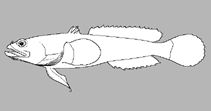
>
Batrachoidiformes (Toadfishes) >
Batrachoididae (Toadfishes) > Halophryninae
Etymology: Triathalassothia: Greek, tres, tria = three + Greek, thalassa = the sea + Greek, thi, suffix that means "where".
Umwelt: Milieu / Klimazone / Tiefenbereich / Verbreitungsgebiet
Ökologie
seewasser demersal. Subtropical
Southwest Atlantic: Uruguay and Argentina.
Größe / Gewicht / Alter
Geschlechtsreife: Lm ? range ? - ? cm
Kurzbeschreibung
Bestimmungsschlüssel | Morphologie | Morphometrie
Rückenflossenstacheln (insgesamt) : 3; Rückenflossenweichstrahlen (insgesamt) : 17 - 18; Afterflossenstacheln: 0; Afterflossenweichstrahlen: 12 - 13; Wirbelzahl: 26 - 27.
Lebenszyklus und Paarungsverhalten
Geschlechtsreife | Fortpflanzung | Ablaichen | Eier | Fruchtbarkeit | Larven
Greenfield, D.W. and T. Greenfield, 1973. Triathalassothia gloverensis, a new species of toadfish from Belize (=British Honduras) with remarks on the genus. Copeia 1973(3):561-565. (Ref. 30720)
IUCN Rote Liste Status (Ref. 130435: Version 2025-2 (Global))
Bedrohung für Menschen
Harmless
Nutzung durch Menschen
Tools
Zusatzinformationen
Download XML
Internet Quellen
Schätzungen auf der Grundlage von Modellen
Phylogenetischer Diversitätsindex (Ref.
82804): PD
50 = 0.7500 [Uniqueness, from 0.5 = low to 2.0 = high].
Bayesian length-weight: a=0.00389 (0.00180 - 0.00842), b=3.12 (2.94 - 3.30), in cm total length, based on all LWR estimates for this body shape (Ref.
93245).
Trophische Ebene (Ref.
69278): 3.5 ±0.5 se; based on size and trophs of closest relatives
Widerstandsfähigkeit (Ref.
120179): mittel, Verdopplung der Population dauert 1,4 - 4,4 Jahre. (Preliminary K or Fecundity.).
Anfälligkeit der Fischerei (Ref.
59153): Low vulnerability (16 of 100).
🛈