>
Siluriformes (Catfishes) >
Trichomycteridae (Pencil or parasitic catfishes) > Sarcoglanidinae
Etymology: Stauroglanis: Greek, stauros = cross + Greek, glanis = a fish that can eat the bait without touching the hook; a cat fish. Glanis was the sacred spirit of springs in the town of Glanum and there was the Glanicae, a triad of local mother goddesses (Ref. 45335).
Eponymy: Dr Michael Goulding (d: 1950) is a conservation ecologist and scientist at the University of Florida and with the Amazon Conservation Alliance with which he has worked for over 30 years. [...] (Ref. 128868), visit book page.
Environnement : milieu / zone climatique / profondeur / gamme de distribution
Écologie
; eau douce démersal. Tropical
South America: Daraá River, Negro River basin.
Taille / Poids / Âge
Maturité: Lm ? range ? - ? cm
Max length : 2.7 cm SL mâle / non sexé; (Ref. 52491)
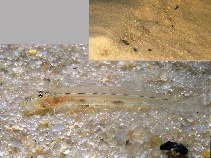
The species is rheophilic. Dwells on patches of loose sand where water flow forms ephemeral sand ripples. Diurnal and mostly visually oriented, forages on aquatic immature benthic insects (dipterans and coleopterans). Moves along the ripple grooves while scanning the bottom back and forth, alternating between adjacent grooves. Feeding activity peaks at late morning and afternoon. When disturbed buries in the sand, and at night remains buried. Seasonal reproduction indicated by mature females caught in the wet months (Ref. 52491).
Cycle de vie et comportement reproducteur
Maturité | Reproduction | Frai | Œufs | Fécondité | Larves
Zuanon, J. and I. Sazima, 2004. Natural history of Stauroglanis gouldingi (Siluriformes: Trichomycteridae), a miniature sand-dwelling candiru from central Amazonia streamlets. Ichthyol. Explor. Freshwat. 15(3):201-208. (Ref. 52491)
Statut dans la liste rouge de l'IUCN (Ref. 130435: Version 2025-2 (Global))
Menace pour l'homme
Harmless
Utilisations par l'homme
Outils
Articles particuliers
Télécharger en XML
Sources Internet
Estimations basées sur des modèles
Indice de diversité phylogénétique (Réf.
82804): PD
50 = 1.0000 [Uniqueness, from 0.5 = low to 2.0 = high].
Bayesian length-weight: a=0.00389 (0.00180 - 0.00842), b=3.12 (2.94 - 3.30), in cm total length, based on all LWR estimates for this body shape (Ref.
93245).
Niveau trophique (Réf.
69278): 3.1 ±0.3 se; based on size and trophs of closest relatives
Vulnérabilité de la pêche (Ref.
59153): Low vulnerability (10 of 100).
🛈