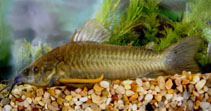
>
Siluriformes (Catfishes) >
Callichthyidae (Callichthyid armored catfishes) > Callichthyinae
Etymology: Hoplosternum: Greek, hoplon = weapon + Greek, sternon = chest (Ref. 45335).
Taxonomic Remarks
See Reis (1997) for phylogeny and Reis (1998) for detailed description.
Environnement : milieu / zone climatique / profondeur / gamme de distribution
Écologie
; eau douce démersal; non migrateur (Ref. 126106); profondeur 1 - ? m (Ref. 11225). Subtropical; 18°C - 26°C (Ref. 2060); 11°N - 37°S
South America: Most Cis-Andean South American river drainages north of Buenos Aires, Argentina (Ref. 37395). Introduced in the USA (Ref. 104645).
Longueur à la première maturité / Taille / Poids / Âge
Maturité: Lm 16.7 range ? - ? cm
Max length : 26.3 cm TL mâle / non sexé; (Ref. 104645); âge max. reporté: 4 années (Ref. 51639)
Description synthétique
Clés d'identification | Morphologie | Morphométrie
Obligate air-breathing (Ref. 126274); Adults inhabit swamps (Ref. 11225). During the rainy season, adults consume a great quantity of chironomids associated with detritus. During the dry season, they feed mostly on terrestrial insects, micro-crustaceans, aquatic Diptera, and detritus. They absorb a great quantity of anaerobic bacteria from the substrate (Ref. 27188). First reproduction occurs after one year (Ref. 35381). Used to be cultured commercially in Guyana (Ref. 7306). Cultured in Trinidad on a semi-commercial scale (Ref. 11225).
Reproduction begins with the rainy season (December-January). The male, at times helped by the female, builds a nest made of a cluster of mucus bubbles and vegetal matter. Responding to a nuptial parade, the female lays down her eggs (5,000 to 20,000, measuring1.8 mm in diameter) which are fertilized by sprinkling sperm previously collected in her mouth. The male guards the eggs during incubation and becomes very aggressive (Ref. 35381).
Reis, R.E., 1997. Revision of the neotropical catfish genus Hoplosternum (Ostariophysi: Siluriformes: Callichthyidae), with the description of two new genera and three new species. Ichthyol. Explor. Freshwat. 7(3-4):299-326. (Ref. 26144)
Statut dans la liste rouge de l'IUCN (Ref. 130435: Version 2025-2 (Global))
Menace pour l'homme
Harmless
Utilisations par l'homme
Pêcheries: commercial; Aquaculture: commercial; Aquarium: Commercial
Outils
Articles particuliers
Télécharger en XML
Sources Internet
Estimations basées sur des modèles
Indice de diversité phylogénétique (Réf.
82804): PD
50 = 0.6250 [Uniqueness, from 0.5 = low to 2.0 = high].
Bayesian length-weight: a=0.02089 (0.01548 - 0.02819), b=2.98 (2.89 - 3.07), in cm total length, based on LWR estimates for this species (Ref.
93245).
Niveau trophique (Réf.
69278): 2.7 ±0.0 se; based on diet studies.
Résilience (Réf.
120179): Milieu, temps minimum de doublement de population : 1,4 à 4,4 années (tmax=4; K=0.6-1.3; Fec = 5,000).
Vulnérabilité de la pêche (Ref.
59153): Low vulnerability (16 of 100).
🛈