>
Syngnathiformes (Pipefishes and seahorses) >
Syngnathidae (Pipefishes and seahorses) > Syngnathinae
Etymology: Hippocampus: Greek, ippos = horse + Greek,kampe = curvature (Ref. 45335).
Eponymy: Georges Bargibant is a biologist and diver at the IRD Centre in Nouméa, New Caledonia, considered to be one of the leading specialists in Indo-Pacific coral environments. [...] (Ref. 128868), visit book page.
More on author: Whitley.
Ambiente: milieu / zona climatica / distribuzione batimetrica / gamma di distribuzione
Ecologia
marino associati a barriera corallina; non migratori; distribuzione batimetrica 0 - 40 m (Ref. 30915). Tropical; 3°N - 23°S
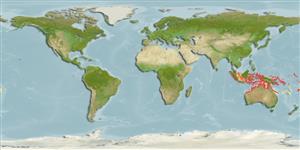
Indo-West Pacific: Indonesia and eastward to Vanuatu; north to Japan; south to Australia.
Lunghezza alla prima maturità / Dimensione / Peso / Età
Maturità: Lm 1.3 range ? - ? cm
Max length : 2.4 cm OT maschio/sesso non determinato; (Ref. 31803)
Breve descrizione
Chiavi di identificazione | Morfologia | Morfometria
Spine dorsali (totale) : 0; Raggi dorsali molli (totale) : 13 - 15. Description based on 4 specimens: Adult height, less than 2.0 cm. Rings, 11-12 + 31-34. Snout length is greater than 4.0 in head length. Dorsal fin rays, 13-15 covering 1+1 rings. Pectoral fin rays, 10. Coronet, a rounded knob. Spine, as irregular bulbous tubercles scattered over body and tail; a single prominent rounded eye spine; a single low rounded cheek spine. Other distinctive characters: head and body very fleshy, mostly without recognizable body rings; ventral portion of trunk segments incomplete; snout extremely short. Color pattern: two color morphs are known: (a) pale grey or purple with pink or red tubercles (found on gorgonian coral Muricella plectana) and (b) yellow with orange tubercles (found on gorgonian coral Muricella paraplectana).
Body shape (shape guide): other.
Only known to occur on gorgonian corals of the genus Muricella, with up to 28 pairs on a single gorgonian. The tubercles and truncated snout of this species match the color and shape of the polyps of the host gorgonian, while its body matches the gorgonian stem. So extreme is this camouflage that the original specimens were only noticed after their host gorgonian had been collected and observed in an aquarium. Post-pelagic young settle on various hosts, but to breed, they appear to prefer the red polyp Muricella spp. That usually grow in depths over 20 m (Ref. 48635). Ovoviviparous (Ref. 205). The male carries the eggs in a brood pouch which is found under the tail (Ref. 205). Minimum depth reported taken from Ref. 128812.
Possibly monogamous in the wild (Ref. 30915). Male carries the eggs in a brood pouch (Ref. 205).
Lourie, S.A., R.A. Pollom and S.J. Foster, 2016. A global revision of the seahorses Hippocampus Rafinesque 1810 (Actinopterygii: Syngnathiformes): taxonomy and biogeography with recommendations for further research. Zootaxa 4146(1):1-66. (Ref. 115213)
Stato della Lista Rossa IUCN (Ref. 130435: Version 2025-2 (Global))
Minaccia per l'uomo
Harmless
Usi umani
Pesca: di nessun interesse
Strumenti
Rapporti speciali
Scarica XML
Fonti Internet
Stime basate su modelli
Temperatura preferita (Fonte Biblio.
123201): 25.9 - 29, mean 27.7 °C (based on 134 cells).
Indice di diversità filogenetica (Fonte Biblio.
82804): PD
50 = 0.5000 [Uniqueness, from 0.5 = low to 2.0 = high].
Bayesian length-weight: a=0.00447 (0.00176 - 0.01132), b=3.00 (2.78 - 3.22), in cm total length, based on LWR estimates for this (Sub)family-body shape (Ref.
93245).
Livello trofico (Fonte Biblio.
69278): 3.4 ±0.4 se; based on size and trophs of closest relatives
Resilienza (Fonte Biblio.
120179): Alto, tempo minimo di raddoppiamento della popolazione meno di 15 mesi (Fec=34).
Vulnerabilità della pesca (Ref.
59153): Low vulnerability (10 of 100).
🛈
Nutrienti (Ref.
124155): Calcium = 294 [140, 691] mg/100g; Iron = 1.19 [0.60, 2.32] mg/100g; Protein = 17.3 [15.9, 18.7] %; Omega3 = 0.152 [0.070, 0.328] g/100g; Selenium = 23.8 [8.4, 66.7] μg/100g; VitaminA = 262 [68, 983] μg/100g; Zinc = 3.31 [1.96, 5.17] mg/100g (wet weight);