>
Anguilliformes (Eels and morays) >
Ophichthidae (Snake eels) > Ophichthinae
Etymology: Ophichthus: Greek, ophis = serpent + Greek, ichthys = fish (Ref. 45335).
Eponymy: Kuna Loa was the Long Eel in Hawaiian mythology. In the legends, the demi-god Maui cut Kuna Loa into pieces, and its tail evolved into the conger eel. (Ref. 128868), visit book page.
More on author: McCosker.
Environnement : milieu / zone climatique / profondeur / gamme de distribution
Écologie
marin bathydémersal; profondeur 220 - 475 m (Ref. 84366). Temperate
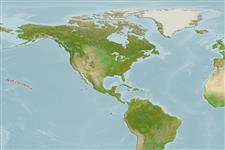
Eastern Central Pacific: Hawaiian Islands.
Taille / Poids / Âge
Maturité: Lm ? range ? - ? cm
Max length : 47.3 cm TL mâle / non sexé; (Ref. 84366)
Description synthétique
Clés d'identification | Morphologie | Morphométrie
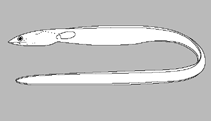
Vertèbres: 180 - 185. This moderately elongate species of Ophichthus, subgenus Coecilophis is distinguished by the following characters: tail 59-60%, head 9.6-10.1% of total length and body depth at gill opening 3.2-3.7% of TL; origin of dorsal-fin above mid pectoral fin; elongate pectoral fin, non-filamentous; posterior margin or orbit in advance of rictus; posterior nostril a hole above upper lip is covered by a flap; no lip barbels; small but conspicuous head pores, SO 1+4, IO 4+2, POM 2+5; small, conical teeth, biserial on anterior vomer and jaws; uniform gray brown in color, lighter ventrally, fins pale except anal which has a dark patch at posterior base; mean vertebral formula 15/66/182, total vertebrae 180-185 (Ref. 84366).
Body shape (shape guide): eel-like.
Benthic on fine sand or hard substrata with crevices (Ref. 58302).
Cycle de vie et comportement reproducteur
Maturité | Reproduction | Frai | Œufs | Fécondité | Larves
Eschmeyer, W.N. (ed.), 1998. Catalog of fishes. Special Publication, California Academy of Sciences, San Francisco. 3 vols. 2905 p. (Ref. 26282)
Statut dans la liste rouge de l'IUCN (Ref. 130435: Version 2025-2 (Global))
Menace pour l'homme
Harmless
Utilisations par l'homme
Pêcheries: sans intérêt
Outils
Articles particuliers
Télécharger en XML
Sources Internet
Estimations basées sur des modèles
Température préférée (Réf.
123201): 13.1 - 13.8, mean 13.6 °C (based on 12 cells).
Indice de diversité phylogénétique (Réf.
82804): PD
50 = 0.5000 [Uniqueness, from 0.5 = low to 2.0 = high].
Bayesian length-weight: a=0.00093 (0.00041 - 0.00214), b=2.99 (2.79 - 3.19), in cm total length, based on LWR estimates for this (Sub)family-body shape (Ref.
93245).
Niveau trophique (Réf.
69278): 3.9 ±0.7 se; based on size and trophs of closest relatives
Résilience (Réf.
120179): Haut, temps minimum de doublement de population inférieur à 15 mois (Preliminary K or Fecundity.).
Vulnérabilité de la pêche (Ref.
59153): Moderate vulnerability (37 of 100).
🛈