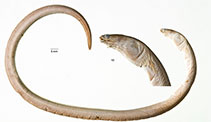
>
Anguilliformes (Eels and morays) >
Ophichthidae (Snake eels) > Ophichthinae
Etymology: Pisodonophis: Greek, piso, pipisko = to drink + Greek, odous = teeth + Greek, ophis = serpent.
Eponymy: Edwin Bingham Copeland (1873–1964) was an American botanist, tropical agriculturalist, physiologist, teacher and administrator. [...] (Ref. 128868), visit book page.
More on author: Herre.
Umwelt: Milieu / Klimazone / Tiefenbereich / Verbreitungsgebiet
Ökologie
seewasser demersal. Tropical
Western Central Pacific: Manila Bay, Luzon, Philippines.
Größe / Gewicht / Alter
Geschlechtsreife: Lm ? range ? - ? cm
Max length : 30.8 cm SL Männchen/unbestimmt; (Ref. 29047)
Kurzbeschreibung
Bestimmungsschlüssel | Morphologie | Morphometrie
Lebenszyklus und Paarungsverhalten
Geschlechtsreife | Fortpflanzung | Ablaichen | Eier | Fruchtbarkeit | Larven
Herre, A.W.C.T., 1953. Eight additions to the Philippine fish fauna, including three new species. Philipp. J. Sci. 82(1):9-14. (Ref. 29047)
IUCN Rote Liste Status (Ref. 130435: Version 2025-2 (Global))
Bedrohung für Menschen
Harmless
Nutzung durch Menschen
Tools
Zusatzinformationen
Download XML
Internet Quellen
Schätzungen auf der Grundlage von Modellen
Phylogenetischer Diversitätsindex (Ref.
82804): PD
50 = 0.5078 [Uniqueness, from 0.5 = low to 2.0 = high].
Bayesian length-weight: a=0.00093 (0.00041 - 0.00214), b=2.99 (2.79 - 3.19), in cm total length, based on LWR estimates for this (Sub)family-body shape (Ref.
93245).
Trophische Ebene (Ref.
69278): 3.6 ±0.6 se; based on size and trophs of closest relatives
Widerstandsfähigkeit (Ref.
120179): hoch, Verdopplung der Population dauert weniger als 15 Monate. (Preliminary K or Fecundity.).
Anfälligkeit der Fischerei (Ref.
59153): Low to moderate vulnerability (28 of 100).
🛈