Elasmobranchii (Haie und Rochen) (sharks and rays) >
Squatiniformes (Angel sharks) >
Squatinidae (Angel sharks)
Etymology: Squatina: Latin for skate, which angel sharks superficially resemble, presumably tautonymous with Squalus squatina Linnaeus 1758 (no species mentioned) (See ETYFish); guggenheim: In honor of the Guggenheim Institución (presumably the present-day John Simon Guggenheim Foundation), which apparently funded the “study trip” (translation) that led to the description of this species (See ETYFish).
Eponymy: The John Simon Guggenheim Memorial Foundation funded the studies of the angelshark’s describer, Tomas Leandro Marini (1902 -1984). (Ref. 128868), visit book page.
Umwelt: Milieu / Klimazone / Tiefenbereich / Verbreitungsgebiet
Ökologie
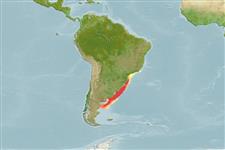
seewasser; brackwasser demersal; tiefenbereich 4 - 360 m (Ref. 57911), usually 4 - 266 m (Ref. 55667). Subtropical; 20°S - 45°S, 68°W - 40°W (Ref. 57911)
Southwest Atlantic: southern Brazil and Argentina.
Länge bei der ersten Reifung / Größe / Gewicht / Alter
Geschlechtsreife: Lm 74.2 range ? - ? cm
Max length : 129 cm TL Männchen/unbestimmt; (Ref. 57911); 130.0 cm TL (female); common length : 89.0 cm TL Männchen/unbestimmt; (Ref. 55667)
Kurzbeschreibung
Bestimmungsschlüssel | Morphologie | Morphometrie
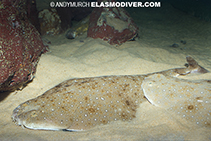
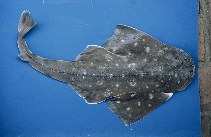
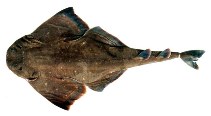
This species is distinguished by the following characters: with a single (or multiple in juveniles) row of enlarged, conical and morphologically distinct dermal denticles over dorsal longitudinal midline, from midlength of the pectoral fin base to origin of first dorsal fin (in some specimens, to origin of caudal fin); dorsal midline denticles are with enlarged and rounded basal plate, 3-4 times diameter of other dorsal denticles, crown with several median ridges (10-12), and crown apex acute and smooth, without ridges (vs. dorsal midline denticles on trunk morphologically similar to other trunk denticles and barely organized in a row in S. occulta and S. argentina); differs from S. occulta by having larger and fewer white blotches on dorsal surface, without surrounding blackish rings (i.e. absence of ocelli-like markings) and smaller in size at maturity, from 73.0-80.0 cm TL (vs. greater than 100.0 cm TL in S. occulta);
differs from S. argentina by its ligther background colour, light to dark brown (vs. dark brown to reddish brown), with larger and fewer white blotches over dorsal surface, with a pair of enlarged, conical and morphologically distinct dermal denticles between spiracles (vs. interspiracular surface covered by smaller dorsal denticles, no enlarged denticles), the lower number of tooth rows with 18-22 vertical rows in both upper and lower jaws, tooth formula 9-9 to 11-11/9-9 to 11-11 (vs. 12-12/12-12 in i>S. argentina), and with a straight external pectoral fin margin (vs. with convex anterior half of external margin). Colouration: dorsal color pattern of light to dark brown background, with several white, creamy-white or yellowish large and rounded blotches variable in size (between one-half to 1.5 times eye-length) on entire dorsal surface (Ref. 95520).
Cross section: angular.
Bony fishes were the main food followed by crustaceans and molluscs (Ref. 55667). Ovoviviparous (Ref. 50449). Adult males are characterized by the presence of a patch of small spines near the tip of the pectoral fins (Ref. 86510).
Ovoviviparous, embryos feed solely on yolk (Ref. 50449). Only the left ovary is functional (Ref. 57911).
Vaz, D.F.B. and M.R. De Carvalho, 2013. Morphological and taxonomic revision of species of Squatina from the Southwestern Atlantic Ocean (Chondrichthyes: Squatiniformes: Squatinidae). Zootaxa 3695(1):001-081. (Ref. 95520)
IUCN Rote Liste Status (Ref. 130435: Version 2025-2 (Global))
Bedrohung für Menschen
Harmless
Nutzung durch Menschen
Fischereien: kommerziell
Tools
Zusatzinformationen
Download XML
Internet Quellen
Schätzungen auf der Grundlage von Modellen
Bevorzugte Temperatur (Ref.
123201): 11.7 - 20.4, mean 15.8 °C (based on 228 cells).
Phylogenetischer Diversitätsindex (Ref.
82804): PD
50 = 0.5000 [Uniqueness, from 0.5 = low to 2.0 = high].
Bayesian length-weight: a=0.00661 (0.00287 - 0.01523), b=3.07 (2.88 - 3.26), in cm total length, based on LWR estimates for this Genus-body shape (Ref.
93245).
Trophische Ebene (Ref.
69278): 4.4 ±0.80 se; based on food items.
Widerstandsfähigkeit (Ref.
120179): sehr niedrig, Verdopplung der Population dauert mehr als 14 Jahre. (Fec=4-10).
Anfälligkeit der Fischerei (Ref.
59153): Very high vulnerability (78 of 100).
🛈
Nährstoffe (Ref.
124155): Calcium = 18.6 [3.4, 85.9] mg/100g; Iron = 0.762 [0.196, 2.146] mg/100g; Protein = 20.1 [18.0, 22.1] %; Omega3 = 0.441 [0.196, 0.945] g/100g; Selenium = 26.6 [7.5, 70.5] μg/100g; VitaminA = 11.3 [4.1, 33.1] μg/100g; Zinc = 0.478 [0.237, 0.881] mg/100g (wet weight);