Elasmobranchii (hajar och rockor) (sharks and rays) >
Torpediniformes (Electric rays) >
Narcinidae (Numbfishes)
Etymology: Benthobatis: Greek, benthos = depth of the sea + Greek, batis, -idos = a ray (Raja sp.) (Ref. 45335); moresbyi: Named for Capt. Moresby of the Indian Navy.
Eponymy: Captain Robert Moresby (1794–1854) of the Indian Navy was a hydrographer, marine surveyor and draughtsman. [...] (Ref. 128868), visit book page.
More on author: Alcock.
Miljö: miljö / Klimatzon / djupintervall / distributionsområde
Ekologi
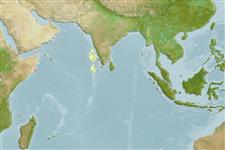
marina djupbottenlevande; djupintervall 787 - 1071 m (Ref. 48493). Deep-water; 15°N - 5°N, 49°E - 77°E (Ref. 114953)
Indian Ocean: Arabian and Laccadive seas (off Travancore coast), Yemen and Somalia; including India (Ref. 118627).
Storlek / Vikt / Ålder
Könsmognad: Lm ? range ? - ? cm
Max length : 35.1 cm TL hane/ej könsbestämd; (Ref. 48493); 39.2 cm TL (female)
Kort beskrivning
Bestämningsnycklar | Morfologi | Morfometri
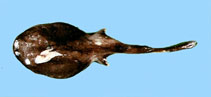
Dark brown dorsal and ventral surfaces; ventral entirely dark. Snout elongated, usually more than 1/3 in disc length (preocular snout region 40% in disc length in lectotype). Disc oval, longer than wide. Dorsal fins with long, fleshy bases which are much longer than height of the fin (dorsal fin length 50-55% of fin height). Origin of first dorsal well anterior to posterior tip of pelvic fins, close to mid pelvic length; dorsal fins close together, interdorsal space less than length of dorsal bases. Distance between second dorsal and caudal fins much smaller than length of base of second dorsal fin. Caudal fin extremely elongated, reaching almost 1/2 tail length as measured from posterior tips of pelvic fins; caudal fin length 40.4% of distance between cloaca and caudal fin tip (Ref. 48493).
Body shape (shape guide): other.
A benthic species on continental slope. Probably suction feeds on bottom-dwelling invertebrates based on its oral morphology. Biology little known. Maturity size uncertain, probably close to 18 cm TL in males (Ref. 114953).
Livscykel och parningsbeteende
Könsmognad | Reproduktion | Lek | Ägg | Fekunditet | Larver
de Carvalho, M.R., 1999. A synopsis of the deep-sea genus Benthobatis Alcock, with a redescription of the type species Benthobatis moresbyi Alcock, 1898 (Chondrichthyes, Torpediniformes, Narcinidae). p. 231-255. In Séret B. & J.-Y. Sire [eds]. Proc. 5th Indo-Pac. Fish Conf., Noumea, 1997. (Ref. 48493)
Status på IUCN:s rödlista (Ref. 130435: Version 2025-2 (Global))
Hot mot människor
Harmless
Mänskliga användningsområden
Verktyg
Särskilda rapporter
Ladda ner XML
Internet-källor
Uppskattningar baserade på modeller
Önskad temperatur (Ref.
123201): 2.7 - 6.7, mean 6.3 °C (based on 5 cells).
Index för fylogenetisk mångfald (Ref.
82804): PD
50 = 0.5625 [Uniqueness, from 0.5 = low to 2.0 = high].
Bayesian length-weight: a=0.01175 (0.00470 - 0.02937), b=2.88 (2.66 - 3.10), in cm total length, based on LWR estimates for this (Sub)family-body shape (Ref.
93245).
Trofisk nivå (Ref.
69278): 3.3 ±0.4 se; based on size and trophs of closest relatives
Resiliens (Ref.
120179): Låg, lägsta populationsfördubblingstid 4,5-14 år (Assuming fecundity<100).
Sårbarhet i fisket (Ref.
59153): Low to moderate vulnerability (29 of 100).
🛈