>
Anguilliformes (Eels and morays) >
Muraenidae (Moray eels) > Muraeninae
Etymology: Gymnothorax: Greek, gymnos = naked + Greek, thorax, -akos = breast (Ref. 45335).
More on author: Seale.
Umwelt: Milieu / Klimazone / Tiefenbereich / Verbreitungsgebiet
Ökologie
seewasser riff-verbunden; tiefenbereich 1 - 40 m (Ref. 30874), usually 20 - 40 m (Ref. 9710). Tropical; 19°N - 18°S
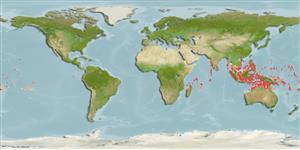
Indo-Pacific: East Africa to the Marquesan and Society islands, north to the Philippines.
Größe / Gewicht / Alter
Geschlechtsreife: Lm ? range ? - ? cm
Max length : 51.9 cm SL Männchen/unbestimmt; (Ref. 137577); common length : 30.0 cm TL Männchen/unbestimmt; (Ref. 30404)
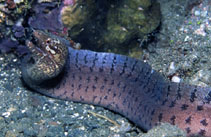
Rückenflossenstacheln (insgesamt) : 0; Rückenflossenweichstrahlen (insgesamt) : 0; Afterflossenstacheln: 0; Afterflossenweichstrahlen: 0; Wirbelzahl: 122 - 130. Color brown with about 4 longitudinal rows of dendritic black blotches; very fine white scribbling anteriorly on body and fins; behind eye an irregular black spot bordered above and below by white; pores on side of jaws in large white spots. Juveniles distinctly marked on the head and adults plain brown, but showing black barring posteriorly on the dorsal and anal fins on the tail (Ref. 48635).
Body shape (shape guide): eel-like; Cross section: compressed.
Occurs in ledges and rubble areas of outer reef slopes to depths of at least 40 m. Feeds on small fishes and crustaceans (Ref. 89972). Usually in caves below 20 m (Ref. 9710, 58302). Secretive in reefs during the day, usually only seen at night (Ref. 48635). Benthic (Ref. 58302). Minimum depth reported taken from Ref. 86942.
Lebenszyklus und Paarungsverhalten
Geschlechtsreife | Fortpflanzung | Ablaichen | Eier | Fruchtbarkeit | Larven
Chen, H.-M., K.-T. Shao and C.T. Chen, 1994. A review of the muraenid eels (Family Muraenidae) from Taiwan with descriptions of twelve new records. Zool. Stud. 33(1):44-64. (Ref. 6934)
IUCN Rote Liste Status (Ref. 130435: Version 2025-2 (Global))
Bedrohung für Menschen
Harmless
Nutzung durch Menschen
Fischereien: weniger kommerziell
Tools
Zusatzinformationen
Download XML
Internet Quellen
Schätzungen auf der Grundlage von Modellen
Bevorzugte Temperatur (Ref.
123201): 26.1 - 28.9, mean 28 °C (based on 294 cells).
Phylogenetischer Diversitätsindex (Ref.
82804): PD
50 = 0.5000 [Uniqueness, from 0.5 = low to 2.0 = high].
Bayesian length-weight: a=0.00055 (0.00036 - 0.00083), b=3.21 (3.09 - 3.33), in cm total length, based on LWR estimates for this species & Genus-body shape (Ref.
93245).
Trophische Ebene (Ref.
69278): 4.0 ±0.6 se; based on size and trophs of closest relatives
Widerstandsfähigkeit (Ref.
120179): mittel, Verdopplung der Population dauert 1,4 - 4,4 Jahre. (Preliminary K or Fecundity.).
Anfälligkeit der Fischerei (Ref.
59153): Moderate to high vulnerability (45 of 100).
🛈
Nährstoffe (Ref.
124155): Calcium = 42.6 [23.7, 81.5] mg/100g; Iron = 0.493 [0.300, 1.023] mg/100g; Protein = 18.8 [16.5, 21.3] %; Omega3 = 0.116 [0.053, 0.332] g/100g; Selenium = 35.5 [19.7, 70.9] μg/100g; VitaminA = 82.7 [25.4, 251.2] μg/100g; Zinc = 1.02 [0.73, 1.41] mg/100g (wet weight);