Ikan bertulang rawan (sharks and rays) >
Myliobatiformes (Stingrays) >
Dasyatidae (Stingrays) > Neotrygoninae
Etymology: Taeniura: Latin, taenia = stripe + Greek, oura = tail (Ref. 45335).
Lingkungan: lingkungan / zona iklim / kisaran kedalaman / jangkauan distribusi
Ekologi
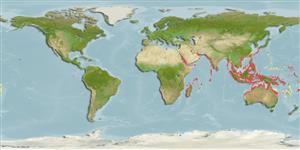
laut berasosiasi dengan karang; kisaran kedalaman 0 - 20 m (Ref. 9840). Tropical; 32°N - 30°S, 32°E - 177°W
Indo-West Pacific: Persian Gulf (Ref.80050); Red Sea and East Africa to the Solomon Islands, north to southern Japan (Ref. 9710), south to northern Australia.
Panjang pada saat jatuh tempo pertama / Ukuran / Berat / umur
Kematangan: Lm 20.3, range 21 - ? cm
Max length : 35.0 cm WD jantan/; (Ref. 58048)
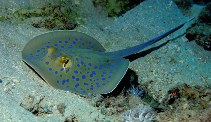
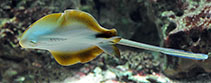
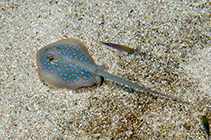
A colorful stingray with large bright blue spots on an oval, elongated disc and with blue side-stripes along the tail; snout rounded and angular, disc with broadly rounded outer corners, and tail stout, tapering and less than twice body length when intact, with a broad lower caudal finfold reaching the tail tip; disc with no large thorns but with small, flat denticles along midback (in adults); usually 1 medium-sized sting on tail further behind base than in most stingrays (Ref. 5578). Grey-brown to yellow, olive-green or reddish brown dorsally, white ventrally (Ref. 5578).
Body shape (shape guide): other.
Occurs around coral reefs (Ref. 6871, 58534). Migrates in groups into shallow sandy areas during the rising tide to feed on mollusks, worms, shrimps, and crabs; disperses on falling tide to seek shelter in caves and under ledges (Ref. 6871). Rarely found buried under the sand (Ref. 12951). Ovoviviparous (Ref. 50449). Small specimens are popular among marine aquarists (Ref. 5578). Does not do well in aquariums (Ref. 12951). Maximum length about 70 cm TL (Ref. 30573). Reports of specimens reaching 240 cm TL are probably inaccurate (Ref. 6871). Commonly caught by fisheries operating over shallow coral reefs and probably adversely affected by dynamite fishing. Utilized widely for its meat (Ref.58048). Minimum depth reported taken from Ref. 86942.
Exhibit ovoviparity (aplacental viviparity), with embryos feeding initially on yolk, then receiving additional nourishment from the mother by indirect absorption of uterine fluid enriched with mucus, fat or protein through specialised structures (Ref. 50449). Distinct pairing with embrace (Ref. 205). Distinct pairing with embrace (Ref. 205). Bears up to 7 young (Ref. 5578, 12951).
Randall, J.E., G.R. Allen and R.C. Steene, 1990. Fishes of the Great Barrier Reef and Coral Sea. University of Hawaii Press, Honolulu, Hawaii. 506 p. (Ref. 2334)
Status IUCN Red List (Ref. 130435: Version 2025-2 (Global))
penggunaan manusia
Perikanan: komersial; Ikan buruan: ya; Akuarium: Komersial
Alat, peralatan
laporan khas
muat turun XML
Sumber internet
Estimasi berdasarkan model
Suhu yang disukai (Acuan
123201): 25.5 - 29.3, mean 28.6 °C (based on 3112 cells).
Indeks keanekaragaman filogenetik (Acuan
82804): PD
50 = 0.7500 [Uniqueness, from 0.5 = low to 2.0 = high].
Bayesian length-weight: a=0.01096 (0.00352 - 0.03419), b=3.12 (2.87 - 3.37), in cm total length, based on LWR estimates for this (Sub)family-body shape (Ref.
93245).
Tingkat Trofik (Acuan
69278): 3.8 ±0.45 se; based on food items.
Daya lenting (Acuan
120179): sangat rendah, Waktu penggandaan populasi minimum lebih dari 14 tahun (Fec=7).
Kerentanan Penangkapan Ikan (Ref.
59153): Very high vulnerability (90 of 100).
🛈
Nutrisi (Ref.
124155): Calcium = 12.1 [1.4, 192.1] mg/100g; Iron = 0.444 [0.037, 4.491] mg/100g; Protein = 20.9 [18.2, 23.6] %; Omega3 = 0.0816 [, ] g/100g; Selenium = 17.6 [3.1, 86.9] μg/100g; VitaminA = 66.2 [5.0, 777.7] μg/100g; Zinc = 1.07 [0.07, 12.22] mg/100g (wet weight);